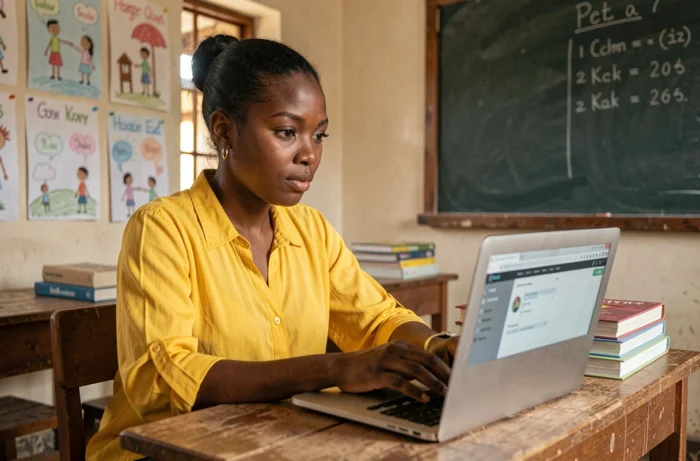
The Sankoré program, named after one of the world’s first universities founded in the 15th century in Timbuktu, was designed to equip African primary schools and colleges with digital tools. Originally led by the Interministerial Delegation for Digital Education in Africa (DIENA), this initiative was based on a technical bet: to provide an interactive whiteboard solution at a controlled cost, around 1,000 euros per class.
Since then, the landscape of digital education on the continent has evolved significantly, and the real place of Sankoré resources in this ecosystem deserves to be questioned.
From interactive whiteboards to national platforms: what Sankoré initiated but could not complete
The initial model of Sankoré was built around three pillars: open-source interactive whiteboard software (Open-Sankoré), a community portal for sharing educational content, and a hardware equipment program primarily targeting Senegal as a pilot country. The stated ambition was to contribute to the Millennium Development Goals, with universal primary education in sight.
What sets Sankoré apart from most contemporary initiatives is the cooperative dimension of content production. The portal sankore.org allowed African, French, and other teachers to create individual workspaces and share their resources. To explore this accessible educational heritage, the resources from the Sankoré site serve as an entry point to freely available content designed for French-speaking education.
However, the program failed to structure a complete ecosystem. Content production relied on the goodwill of volunteer teachers, without a sustainable remuneration mechanism or systematic editorial validation. The absence of a sustainable economic model hindered scaling up.
Digital educational strategy in Senegal: a framework that goes beyond the Sankoré model
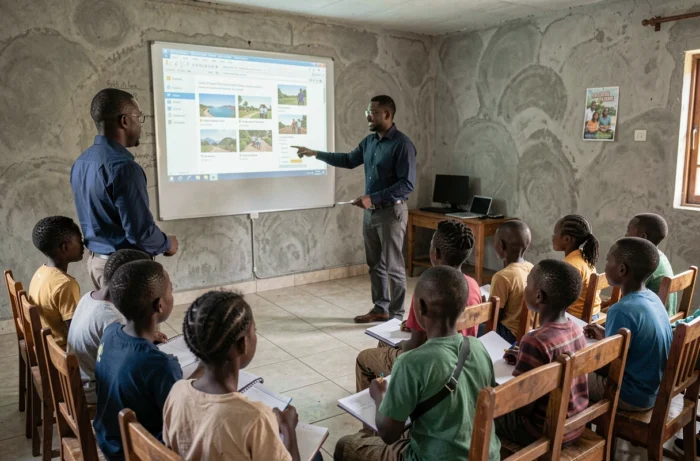
Senegal, which was the primary testing ground for Sankoré, has since taken a structural turn. In early 2025, the Senegalese government launched a Digital Strategy for Education covering the period 2025-2029, with a budget of 130 billion CFA francs. The goal: to connect more than 22,000 schools, distribute tablets and educational kits, and structure ongoing teacher training through a dedicated digital university.
This plan relies on a set of five educational platforms scheduled for deployment starting in 2026-2027:
- A centralized administrative management platform for monitoring institutions and enrollment
- A data-driven educational management tool for decision-makers and academic inspections
- A national digital library grouping textbooks, exercises, and multimedia resources
- An online continuous training system for teaching and administrative staff
- An accessible learning and remediation platform for students
The difference with Sankoré is structural. While the initial program offered a tool (the interactive whiteboard) and a community portal, current national strategies integrate digital education into a comprehensive governance architecture. Educational content is no longer a byproduct of teacher volunteering, but a component driven by performance indicators.
Open-source software and open content: a relevant Sankoré legacy
Open-Sankoré, the open-source interactive whiteboard software developed under the program, remains an interesting case study in the history of digital education in Africa. Its open-source code allowed any institution to adapt it without licensing fees, a significant advantage in contexts where IT budgets are constrained.
The principle of open-source software applied to education raises a question that the new national strategies have yet to resolve. Will the five planned platforms in Senegal rely on proprietary solutions or on open-source components? Field feedback varies on this point: some stakeholders advocate for sovereign and adaptable solutions, while others prefer proven turnkey platforms already tested on a large scale.
The pooling of French-speaking educational resources initiated by Sankoré remains highly relevant. In a context where several West African countries share the same core curricula, having a reservoir of free and interoperable content avoids duplicating production efforts country by country.
The limits of the community production model
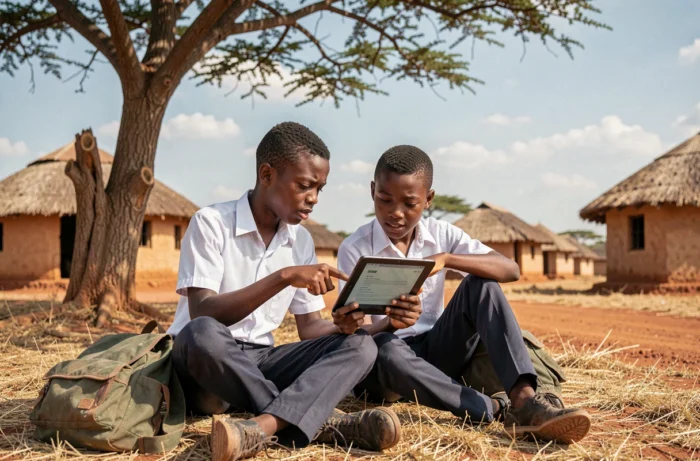
Placing teachers in a cooperative production mode, as the program formulated in its early days, requires conditions that are rarely met: stable internet access, time freed outside of class hours, and minimal technical skills in creating digital content. The available data does not allow for precise measurement of how many teachers have actually contributed to the Sankoré portal over time.
This observation does not invalidate the model. It highlights that the production of digital educational content requires institutional support, not just technical infrastructure. This is precisely what the new national strategies are attempting to correct by integrating ongoing training as a fully-fledged pillar.
Digital education in Africa: between acceleration and persistent fractures
Several African countries have adopted structured national strategies since 2024 that go beyond the initial interactive whiteboard model. Ethiopia, for example, has developed a framework dedicated to integrating artificial intelligence into education, in response to a significant digital skills gap within its population. Botswana and Namibia are working with UNESCO to strengthen quality assurance to prepare higher education for the digital transition.
These dynamics should not mask the fractures. Connectivity remains the main bottleneck in the majority of rural areas on the continent. An interactive whiteboard or an online learning platform does not function without reliable electricity or internet connection. The Sankoré program was indeed designed to operate partially offline, a constraint that the cloud architectures of the new platforms do not always take into account.
The legacy of Sankoré is measured less by its quantitative results than by the question it first posed on a large scale: how to produce and distribute digital educational content adapted to African realities, in French, with limited resources. The answers have changed, but the question remains the same.