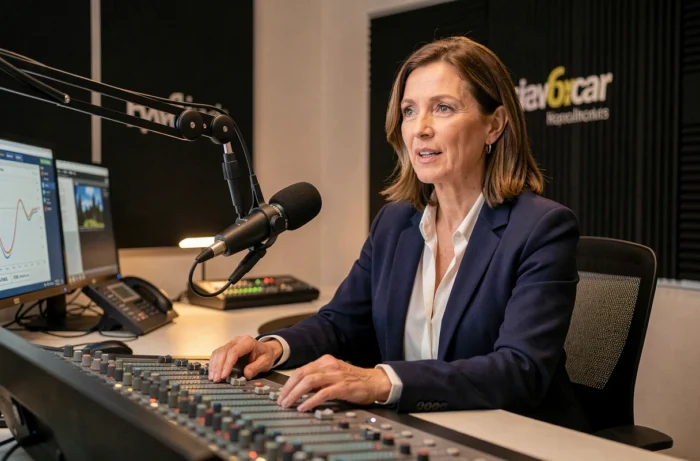
Apolline de Malherbe is one of the most visible faces in the French audiovisual landscape. A journalist and host on RMC and BFMTV, she hosts several daily shows within the same media group. Her salary, frequently commented on in the gossip press, remains shrouded in mystery due to the lack of a legal obligation to publish salaries in the private sector.
Compensation of audiovisual journalists: an inherently opaque framework
Unlike executives of publicly traded companies, salaried journalists in the private sector are not required to disclose their income. The salary scales of collective agreements in the press and audiovisual sectors set minimums, but star presenters negotiate individual contracts that far exceed these floors.
This opacity explains why the amounts circulating regarding Apolline de Malherbe are estimates, never official figures. Several media outlets provide ranges, but none are confirmed by the individual or her employer. To view a detailed analysis of Apolline de Malherbe’s salary on RMC, the compiled estimates provide a scale consistent with the market for morning radio and television in France.
One contextual element deserves mention: a draft law transposing the European directive 2023/970 on salary transparency was subject to an opinion on June 29, 2026. If this transposition is successful, media companies may be required to provide more information on pay disparities, including for high-visibility positions.

Apolline de Malherbe on RMC and BFMTV: multiple channels, multiple sources of income
The compensation of a presenter like Apolline de Malherbe is not limited to a single paycheck for one show. As of the start of the 2026 school year, she is beginning her seventh year hosting the 7-9 on RMC, the flagship morning slot of the station.
Her scope does not stop there. She also hosts Apolline from 9 to 10 on BFMTV and Apolline at your place on RMC Story. The Face-to-Face segment in the last half-hour of the 7-9 is co-broadcast on BFMTV, which multiplies the audience and, logically, the value of her contract.
This presence across multiple channels of the same group (radio, television, replay via RMC+ and RMC BFM Play) serves as a leverage point for salary negotiations. The more slots a presenter fills, the more her weight in the schedule justifies a higher overall compensation.
What this versatility changes in the calculation
A journalist confined to a single time slot on one channel does not generate the same advertising value as a face appearing in three formats. The diversification of channels strengthens Apolline de Malherbe’s contractual position against her management.
The advertising revenues from morning radio shows are among the highest in the French audiovisual market. The 7-9 on RMC, with its format combining political news and debate, attracts advertisers targeting urban professionals. The presenter who leads this segment captures a portion of that value in her compensation.
Apolline de Malherbe’s salary compared to her predecessors: the Bourdin controversy
Apolline de Malherbe herself fueled the debate by publicly stating that her salary was lower than that of her predecessor, Jean-Jacques Bourdin. This statement, reported by Gala, highlighted a recurring phenomenon in the audiovisual sector: the pay disparities between generations of presenters.
Jean-Jacques Bourdin, a historic figure of the RMC morning show, negotiated his contract at a time when the station was trying to establish itself against its competitors. His salary reflected a context of bidding wars to attract talent. Apolline de Malherbe took over the airwaves in a different context, with a media group focused on cost control.
The fact that she publicly expressed her disappointment on this subject is revealing in itself. Star journalists rarely discuss their pay, and this statement has been interpreted as a signal to both her management and the public.
Apolline de Malherbe’s wealth and assets: what the estimates cover
Several specialized sites publish estimates of Apolline de Malherbe’s fortune. These figures generally aggregate several components:
- The total of salaries earned over several years in the audiovisual sector, first in reporting positions and then as a lead presenter
- Any additional income related to speaking engagements, conferences, or editorial collaborations outside her main contract
- The family wealth, as Apolline de Malherbe comes from a family rooted in the art and cultural heritage sector
Differentiating professional income from inherited wealth or assets acquired through other means remains a speculative exercise. The available estimates often mix these two dimensions without detailing them.
Why these estimates remain approximate
No public tax document allows for verification of the amounts claimed. The sites that publish these figures rely on cross-references (conventional scales, comparisons with other presenters, indirect statements) but never on verifiable accounting sources.
This caution is necessary to avoid taking at face value estimates that are more akin to analogy-based calculations than to financial investigation.

Salary transparency in the media: what could change
The French audiovisual sector still operates on a model of individual negotiation where presenters’ salaries remain confidential. The European directive 2023/970, currently being transposed into French law, could alter this balance.
If the law requires companies to report on pay disparities by job category, media groups will have to provide aggregated data. This does not mean that Apolline de Malherbe’s exact salary would become public, but that disparities within a newsroom would be better documented.
For journalists as well as viewers, this regulatory evolution represents a paradigm shift. The compensation of media figures could become a less speculative topic as transparency obligations strengthen. Until then, the estimates published regarding Apolline de Malherbe’s wealth and salary will remain what they are: approximations based on indices, not on evidence.