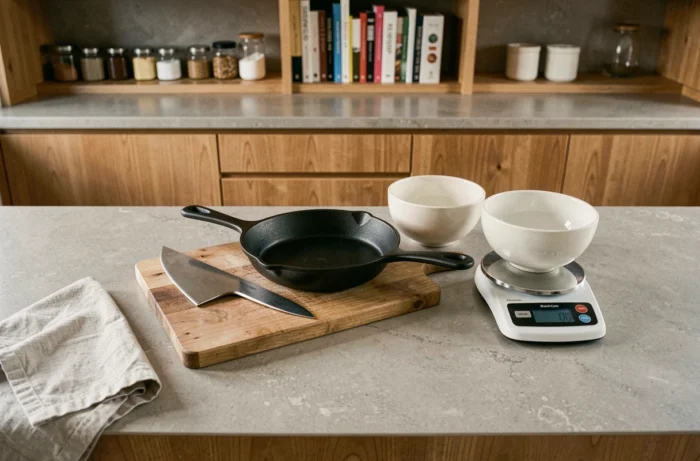
A dish that sticks to the bottom of the pan, a sauce impossible to emulsify, vegetables cut unevenly: most kitchen failures do not stem from the recipe, but from the equipment used. Choosing the right kitchen tools changes the precision of movements, the consistency of cooking, and the joy of cooking every day.
Cooking materials: why stainless steel and cast iron change your results
Have you ever noticed that the same steak yields a very different result depending on the pan used? The reason lies in the thermal conductivity of the material and its heat retention capacity.
A thick-bottomed stainless steel pan heats up quickly and maintains an even temperature. It allows you to sear meats and fish without excessive heat points on the edges. Stainless steel withstands acidic deglazing (wine, lemon, vinegar) without altering the taste of the dish, making it the natural choice for sauces.
Heavier cast iron excels in long cooking. An enameled cast iron pot maintains a steady simmer for hours with minimal energy. For those looking for reliable equipment tested by other amateur cooks, you can visit La Cuisine de Watoote to compare the features of each type of utensil.
Non-stick cookware remains useful, but for targeted uses: crepes, omelets, dry cooking of delicate fish. A good non-stick surface does not replace a stainless steel pan, it complements it.
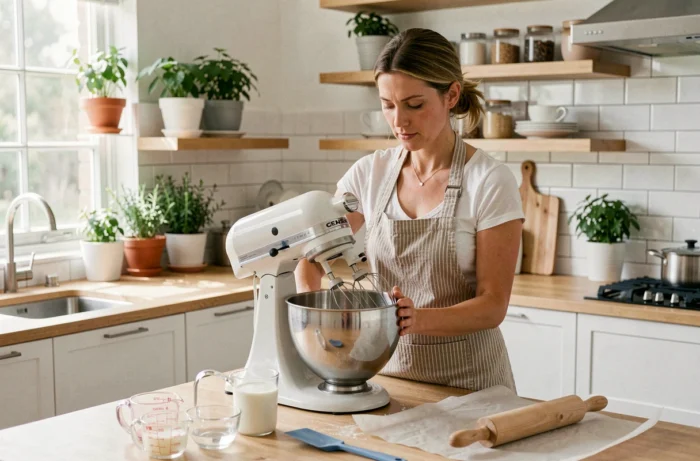
Chef’s knife and cutting board: the duo that conditions preparation
Even before turning on the heat, the quality of the cut determines the cooking. Uneven pieces cook inconsistently: some are charred while others remain raw in the center.
A versatile 20 cm chef’s knife covers most needs: slicing an onion, chopping herbs, cutting a butternut squash. A paring knife (8 to 10 cm) complements the duo for precision tasks, such as segmenting citrus or peeling a round vegetable.
Blade maintenance
A knife that cuts poorly requires force. This tires the wrist and makes movements imprecise. A ceramic or steel honing rod can straighten the blade’s edge before each cutting session. Sharpening with a stone is done a few times a year to reform the edge.
A hardwood cutting board (beech, maple) preserves the knife’s edge better than glass or rigid plastic. Wood absorbs shocks without deforming the blade, and its fibers partially close after cutting, limiting bacterial growth if the board is properly washed and dried.
Air fryer and versatile small appliances: what has truly changed in the kitchen
According to an Ifop study conducted for Pyrex, 45% of French people now own an air fryer, and more than half of these devices were purchased in the past year. This figure illustrates a concrete shift in habits.
More than 80% of owners report that the device has changed their cooking style. The main reasons cited are:
- Time savings, with almost instant preheating compared to a conventional oven
- The ability to cook healthier by significantly reducing the amount of fat needed
- Energy savings, as an air fryer consumes significantly less than a traditional oven for individual or family portions
The air fryer replaces or complements the oven for a large part of everyday meals. It is no longer a gadget, but a pivotal tool for quick cooking: roasted vegetables, breaded fish, individual gratins.
Immersion blender and kitchen scale
An immersion blender remains the most versatile small appliance in the drawer. It is used to emulsify a vinaigrette, blend a soup directly in the pot, or prepare a quick compote. Its main advantage: it washes in seconds under the tap, unlike a traditional blender.
The kitchen scale (electronic, gram precision) eliminates guesswork in baking. An excess of flour by just a few tens of grams can make a cake dense. In baking, weighing each ingredient is the only guarantee of consistency.
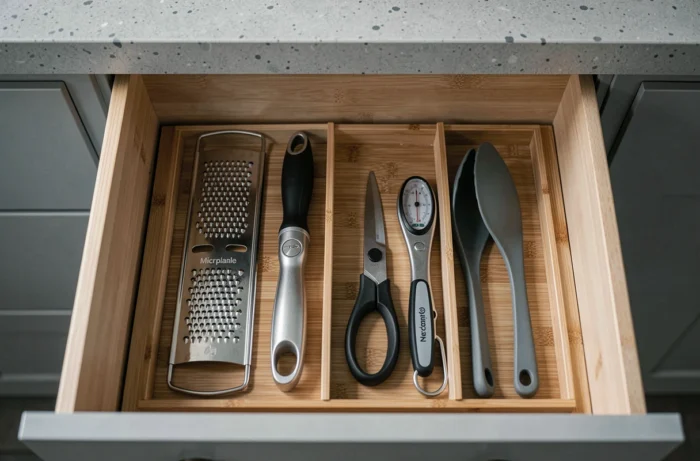
Often overlooked cooking utensils: silicone spatula, tongs, and thermometer
Some inexpensive accessories can significantly enhance comfort and precision in the kitchen. Three of them deserve a permanent place next to the stovetop:
- The silicone spatula resists heat without scratching non-stick coatings. It retrieves every bit of a mixture from a bowl, preventing waste and making cleanup easier
- The stainless steel kitchen tongs (about 30 cm) replace a fork for flipping food without piercing it. A pierced piece of meat loses its juices, while tongs preserve them
- The probe cooking thermometer removes any uncertainty about the internal temperature. A roasted chicken reaches the right texture between 74 and 76 °C internally, while a duck breast is served pink around 54 °C. Without a thermometer, you guess. With one, you control
A cooking thermometer costs just a few euros and eliminates guesswork in cooking. For anyone who regularly cooks meats or fish, it represents the best value for money investment.
Being well-equipped does not mean accumulating entire drawers of gadgets. A few well-chosen utensils (a stainless steel pan, a well-maintained chef’s knife, a scale, a thermometer) are enough to cover most recipes. The rest is a matter of technique, and technique progresses much faster when the equipment does not hinder the movement.