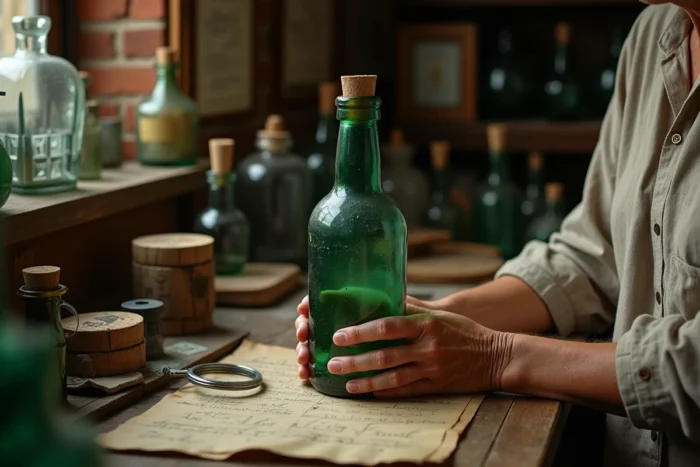
Dating an antique glass bottle relies on a set of physical clues, each linked to a specific manufacturing period. Mold seams, lip type, glass color, base markings: these elements intersect to place an object in time. However, one must know which clues to observe first and which can be misleading.
Mold seams and manufacturing traces: what glass remembers
The seam (or mold line) running along the body of a bottle is the first reliable indicator. On a mouth-blown bottle, the seam stops well before the lip, often at the shoulder. On a mechanically molded bottle, it extends up to the top of the neck and sometimes continues onto the lip itself.
A seam that stops below the neck generally indicates a manufacture prior to the 1900s. When it reaches the top of the lip without interruption, the bottle most often dates from the 20th century, a period when Owens-type machines became widespread.
Experienced collectors also note the presence of a pontil (rough circular mark on the base) on hand-blown bottles, typical of the pre-industrial period. This marker disappears with the systematic use of solid-bottom molds. To deepen the understanding of these chronological clues, the sheets published on the Jardindivert website detail the various blowing techniques and their dating.
Summary table: observable clues and associated periods
| Observable clue | Characteristic | Probable period |
|---|---|---|
| Pontil mark on the base | Rough, irregular scar | Before about 1860 |
| Seam that stops at the shoulder | Short mold line | Before 1880 |
| Seam up to the neck (not the lip) | Lip finished by hand | 1880-1910 |
| Continuous seam to the lip | Completely mechanical manufacture | After 1910 |
| Irregular air bubbles in the glass | Imperfect artisanal melting | Before 1900 |
| Raised codes on the base | Numbers, letters, glassmaker symbols | 20th century (industrial) |
This table serves as a quick reference guide, but each clue must be cross-referenced with others. A short seam combined with thick, bubbly glass points to an old manufacture. In contrast, a short seam on perfectly homogeneous glass may indicate a recent artisanal reproduction.
Color of antique glass: decoding shades linked to processes
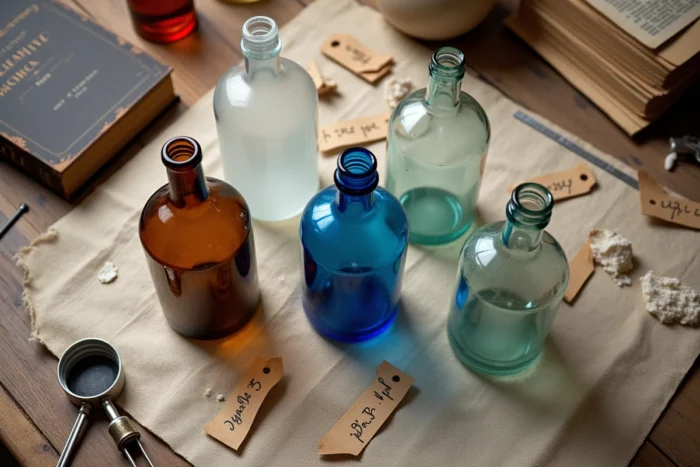
The hue of a bottle is not an aesthetic choice: it depends on the raw materials and melting techniques available at a given time. Aqua glasses (pale blue-green) indicate un-decolorized glass, common before the end of the 19th century, when the natural iron in sand was not corrected.
Deep amber shades and dark olive greens are found on wine or beer bottles made over long periods, making them less discriminating for dating. In contrast, certain colors (cobalt, amethyst, opaque milk) appear within narrower historical windows.
A phenomenon particularly interests collectors: manganese glass that turns purple under the effect of solar UV. This type of glass, used as a decolorizer from around 1880 to World War I, reveals its age through this gradual coloration. Recent guides also recommend using a UV lamp to distinguish antique glass from a reproduction by observing the fluorescence related to certain additives.
Base markings and glassmaker codes: reading the underside of a bottle
Turning the bottle over is a reflex that many beginners forget. On industrial bottles from the 20th century, raised codes on the base (two digits, letters, symbols) may correspond to manufacturing dates, mold numbers, or glass factories. These marks are read by comparing them to the overall style of the bottle and any potential label.
A common mistake is to interpret a mold number as a production year. The number “43” does not automatically mean 1943; it may refer to a specific mold reused for decades. Databases like Glass Bottle Marks catalog symbols from several hundred glassworks, allowing for cross-referencing a logo with a known activity period.
Another trap: old molds reused for recent bottlings. A bottle may bear a mark from a glassworks that has been closed for a long time while being filled well after. Only the cross-referencing of multiple clues (patina, seam, lip style, residual content) protects against erroneous dating.
Weight, irregularities, and patina: clues that the hand detects before the eye
Experts in artisanal glass emphasize analyzing weight, irregular thickness, and small shape imperfections to distinguish antique glass from a modern molded object. An item that is too regular, too light, and perfectly identical to others should raise suspicion of recent industrial production, even if the decor looks “antique.”
Consistent micro-wear constitutes another reliable marker. On the foot and support areas, a truly old bottle shows progressive, uneven wear, with fine scratches oriented in multiple directions. An artificial patina, on the other hand, appears too homogeneous.
- Run your finger along the lip: a hand-applied lip has a slight irregular bulge, while a mechanical lip is smooth and symmetrical.
- Observe the base in the light: air bubbles trapped in antique glass vary in size and are randomly distributed, whereas modern glass contains very few.
- Compare the weight of two bottles of the same size: a notable difference between two supposedly identical specimens reveals a handmade production where each piece differs.
Dating an antique glass bottle never relies on a single criterion. A seam, a color, or a base code taken in isolation can be misleading. It is the convergence of multiple physical clues that anchors the dating within a credible range, and it is precisely this cross-referenced reading that separates reliable estimation from speculation.