Artisanal vegetable gold has nothing to do with solid gold. This material, often made of natural fibers covered with a thin layer of gilding or worked with brass, reacts very differently to the cleaning methods commonly found on the Internet. Applying classic recipes meant for 18-carat gold jewelry can cause irreversible damage to a handcrafted piece made of vegetable gold.
Vegetable gilding and solid gold: why confusing them damages your jewelry
Most online guides address the cleaning of solid gold or gold plated on a metal base. Vegetable gold relies on an organic support (fibers, grasses, capim dourado) that cannot withstand the same stresses as a metal alloy.
A prolonged soak in warm soapy water, a standard method for an 18-carat gold ring, can cause the vegetable fibers to swell and the gilding to detach. White vinegar, baking soda, and ammonia, often recommended for silverware or tarnished jewelry, cause immediate and irreversible damage to the layer of gold applied to a vegetable support.
To learn how to clean artisanal vegetable gold, the first rule is to forget everything that works on classic gold. The vegetable support requires a radically different approach.
Cleaning vegetable gold: the only actions that do not damage the gilding
Gold leaf gilding specialists recommend a dry dusting with a very soft brush as the only routine maintenance action. This precaution also applies to artisanal vegetable gold, whose gilded layer is even thinner and more fragile than gilding on wood or metal.
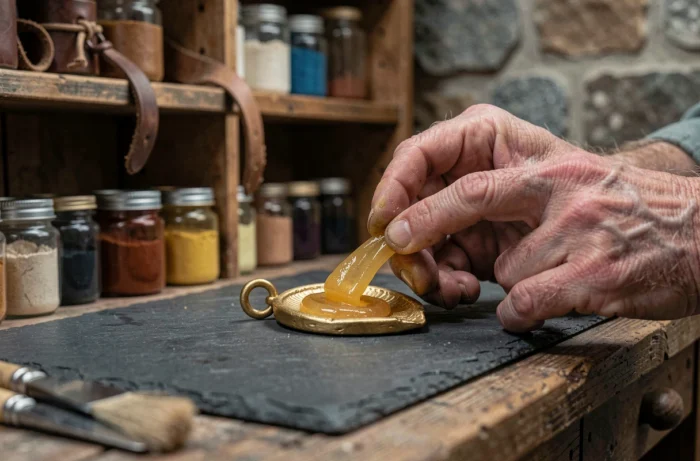
A natural bristle brush (like a clean kabuki makeup brush, not used with cosmetics) can remove dust without scratching the surface. The action should remain light, without pressure.
If a stain persists, a very slightly damp (not wet) soft microfiber cloth can be passed over the affected area. The jewelry should then be dried immediately with a second dry cloth.
- Soft natural bristle brush for daily dusting, without any products
- Barely damp microfiber cloth for stubborn marks, followed by immediate drying
- Non-impregnated chamois to gently polish the gilded surface without scratching
- Dry cotton swab to reach the corners of worked or braided pieces
Water should never stagnate on vegetable gold. Prolonged contact with moisture causes the organic support to swell and can lead to the gilding detaching within hours.
Storage and oxidation: what tarnishes vegetable gold even before wearing it
The tarnishing of vegetable gold often begins in the drawer, not on the wrist. A piece of jewelry stored in a bathroom, near a window, or in an open box is subjected to ambient humidity and temperature fluctuations.
Recent recommendations for maintaining brass jewelry (a common material in the base of vegetable gold pieces) emphasize storing in a closed and dry container. The original packaging, a fabric pouch, or an airtight box slow down the oxidation of the surface.
A few storage precautions can change the lifespan of a piece:
- Store each piece of jewelry separately to avoid friction between pieces
- Slip a small silica gel pouch into the box to absorb residual moisture
- Keep jewelry away from perfumes, creams, and cosmetic products, which attack the gilding upon contact
The oxidation of brass under the gilding produces a characteristic greenish hue. Once this reaction begins, the process is difficult to reverse without damaging the layer of gold. Prevention remains the only reliable strategy.
Prohibited products on vegetable gold: the list that classic guides do not mention
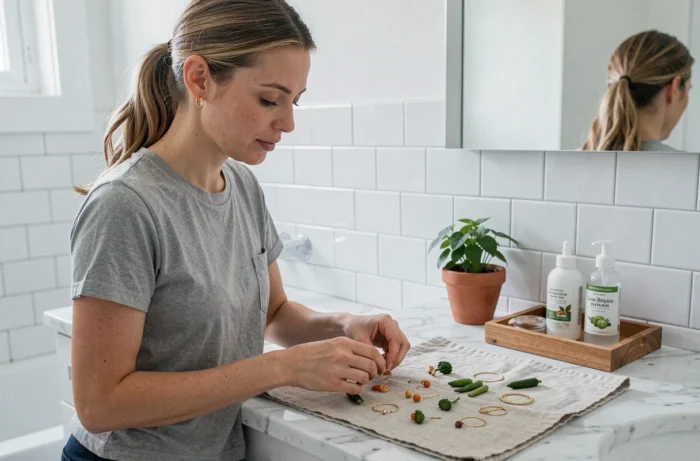
Jewelry cleaning tutorials regularly recommend white vinegar, baking soda, toothpaste, or multipurpose sprays. On artisanal vegetable gold, these products should be strictly avoided without exception.
White vinegar attacks the gilding layer through an acidic reaction. Baking soda, even diluted, acts as a microscopic abrasive that scratches the surface. Toothpaste contains polishing agents designed for dental enamel, far too aggressive for a gold leaf on a vegetable support.
Multipurpose sprays and commercial waxes should also be avoided, as they leave a chemical film that traps moisture beneath the surface and accelerates oxidation. Washing soda, sometimes mentioned for silverware, causes the same type of damage.
The only acceptable product in contact with vegetable gold remains clear water, in minimal quantity and for a very short time. Everything else is a risk.
Wearing vegetable gold daily without prematurely wearing it out
The order in which you dress has a direct impact on the longevity of a piece of vegetable gold jewelry. Perfume, sunscreen, and makeup should be applied and dried before putting on the jewelry. This simple action limits contact with the most common chemical agents.
Removing vegetable gold jewelry before showering, swimming, or exercising remains the most effective precaution. Sweat combined with heat accelerates the tarnishing of the gilding, even on well-made pieces.
After a day of wear, a quick pass with the soft brush is enough to remove micro-residues before storage. This ritual of a few seconds preserves the shine much more effectively than a deep cleaning done once a month.
Artisanal vegetable gold is a living material, not an inert metal. Its fibers react to moisture, heat, and chemicals in a way that solid gold ignores. Treating it as such, with simple actions and attention to storage, remains the only way to sustainably maintain its golden appearance.