The cat’s kidneys filter metabolic waste, regulate blood pressure, and maintain calcium and phosphorus balance. When these functions decline, the consequences affect the entire organism.
Hydration plays a direct role in the workload imposed on the kidneys: drinking sufficient water dilutes toxins and limits urinary concentration. Water fountains equipped with anti-limescale filters are often presented as a solution to protect kidney function, but their actual benefits deserve careful examination.
Limescale and Cat Kidney Health: What the Regulations Really Say
Most articles on the subject imply that reducing limescale in water protects the cat’s kidneys. The regulatory reality is more nuanced.
In France, there is no health limit governing the hardness of drinking water. The calcium and magnesium present in tap water are considered useful minerals. ANSES reminds us that they contribute to the recommended daily intake, including for pets.
Limescale poses a comfort issue (deposits on appliances, altered taste), not a demonstrated health problem. No study has established that hard water increases the risk of kidney failure in cats, as long as this water meets drinking water standards. Choosing an anti-limescale fountain can preserve your cat’s kidney health by improving the taste of the water and encouraging them to drink more, which remains the main lever.
The real risk lies on the opposite side: water that is too demineralized can deplete mineral intake and alter sodium content. For a cat already suffering from kidney failure, this imbalance can worsen the situation. Domestic water softeners, which replace calcium with sodium, are not recommended without veterinary advice.
Biofilm in the Water Fountain: An Underestimated Danger for Cats
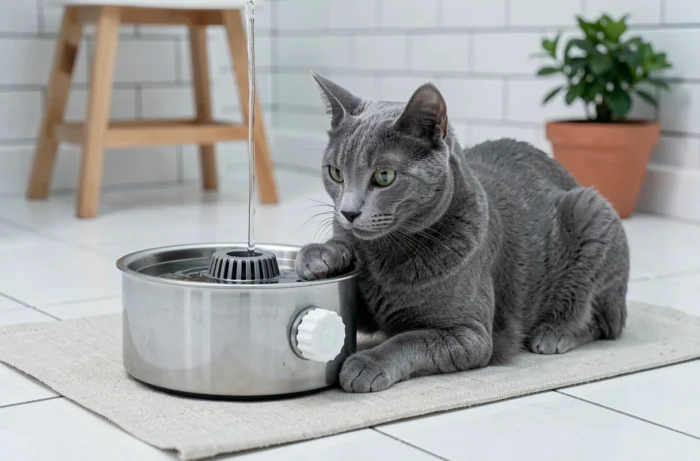
The viscous deposit that forms on the walls of a fountain has a name: biofilm. It is a community of bacteria that adhere to wet surfaces and protect themselves under a slimy matrix. This biofilm develops within a few days in any poorly maintained fountain, regardless of the type of filter installed.
The problem goes beyond mere hygiene. A mature biofilm contains pathogenic bacteria capable of causing urinary or gastrointestinal infections. For a cat whose kidneys are already functioning slowly, any additional infection accelerates renal degradation.
Anti-Biofilm Maintenance: Concrete Actions
- Completely disassemble the fountain once a week and scrub each component with a soft brush, without harsh chemicals
- Replace the activated carbon filter according to the frequency indicated by the manufacturer, as a saturated filter itself becomes a breeding ground for bacterial proliferation
- Prefer ceramic or stainless steel fountains, as their smooth surfaces slow down biofilm adhesion compared to plastic
- Rinse the reservoir and refresh the water every two to three days, even if the level seems sufficient
An anti-limescale filter reduces mineral deposits, making cleaning easier. Its effect on kidney health remains indirect: fewer deposits mean simpler maintenance, thus cleaner water.
Moving Water and Feline Drinking Behavior
The cat descends from ancestors adapted to arid environments. Its thirst instinct is naturally weak, which explains why many cats fed dry food drink less than their actual needs. A stagnant water bowl does not always trigger the drinking reflex.
Moving water produces a visual and sound signal that the cat associates with a fresh source. Fountains exploit this mechanism: the continuous flow attracts the animal and encourages it to drink more frequently. Increasing the volume of water ingested dilutes urine, reducing the concentration of calcium oxalate crystals and struvite.
Wet Food and Combined Hydration
A fountain alone is not sufficient if the diet consists exclusively of dry food. Wet food or canned food provides a significant portion of the daily water needed. Combining a fountain and wet food remains the most effective hydration strategy to support kidney function.
Placing the fountain away from the food bowl and litter box respects the cat’s territorial behavior. A cat that has to cross its living space to access water reproduces a more natural pattern, which encourages regular visits.
Anti-Limescale Filtration: Activated Carbon, Ion Exchange Resin, or Ceramic
Commercial fountains use three main filtration technologies, each affecting water quality differently.
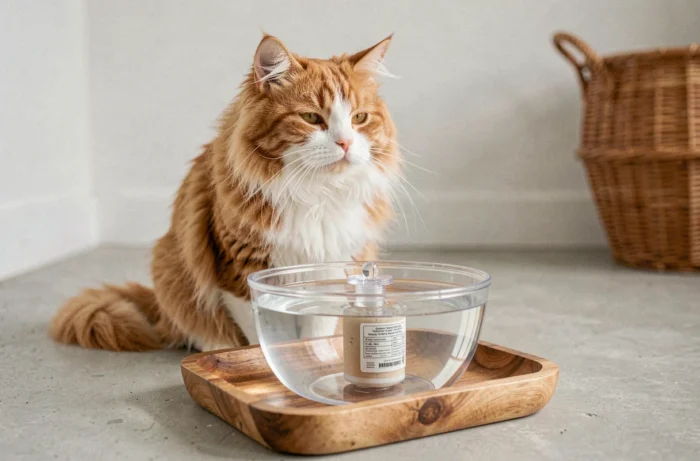
The activated carbon filter absorbs chlorine, organic impurities, and certain compounds responsible for bad taste. It does not strictly remove limescale but improves the palatability of the water, encouraging the cat to drink more.
The ion exchange resin captures calcium and magnesium ions and replaces them with sodium. This process effectively reduces water hardness. For a cat with kidney insufficiency on a low-sodium diet, this type of filter requires particular vigilance.
Ceramic filters retain fine particles and certain bacteria due to their porosity. They do not alter the mineral composition of the water. Their main advantage lies in durability and the absence of chemical leaching.
- For a healthy cat in a moderately hard water area: an activated carbon filter is more than sufficient
- For a cat with urinary history in a very hard water area: a filter combining activated carbon and ion exchange resin offers a compromise
- For a cat with kidney insufficiency under treatment: seek veterinary advice before altering the mineral composition of drinking water
The hardness of water varies significantly from one municipality to another in France. Interactive maps available on data.gouv.fr allow you to check local hardness before choosing a suitable filtration system.
The most expensive filter is not necessarily the most relevant. A cat that regularly drinks clean, frequently refreshed water gains more renal benefits than a cat facing a sophisticated but poorly maintained fountain. The regularity of maintenance takes precedence over filter technology.