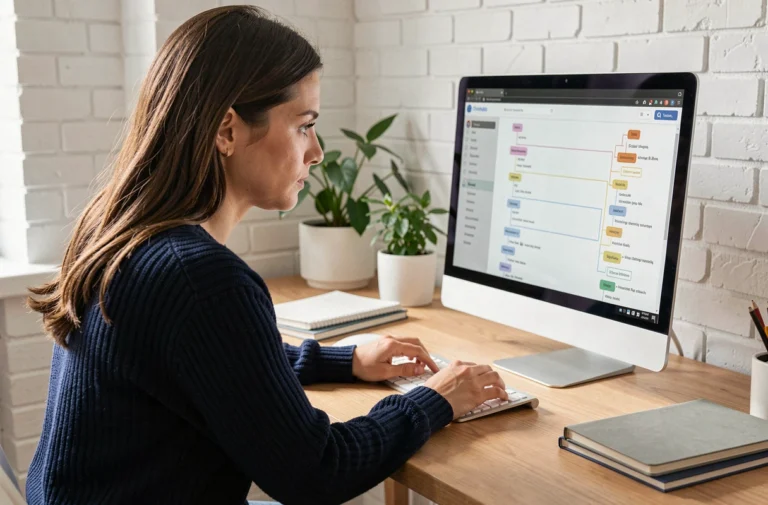
On a parenting blog, articles accumulate quickly. Infant sleep, complementary feeding, hands-on activities, choosing the first school bag: each topic generates multiple pages. The sitemap is the page that gathers all this content in the form of organized links. It functions like an interactive table of contents, accessible with one click, which avoids digging through menus or typing random keywords.
Structure of a sitemap on a parenting blog
A sitemap lists all published pages, categorized by topics. On a blog dedicated to parenting, these categories correspond to the main themes that parents search for: pregnancy, early development, health, education, family leisure.
Each category contains links to related articles. Looking for a comparison of strollers published six months ago? You can find it under the equipment section, without scrolling through the entire news feed.
The Vive Mon Bébé sitemap illustrates this principle well: articles are sorted by themes (birth, childcare, daily life), allowing direct access to the section that concerns you.
A well-structured sitemap significantly reduces search time. Instead of scrolling endlessly, you navigate a clear hierarchy and click on the exact title that interests you.
What each section contains
The sections are not just simple alphabetical lists. They group content by parental logic:
- Articles related to pregnancy and childbirth preparation, for expectant parents who need progressive information month by month
- Practical guides on equipment (strollers, car seats, baby beds), often the most consulted in the first weeks
- Content on early development, leisure, and activities for children, categorized by age group when the blog allows
- Pages related to health, safety, and digital privacy, an increasingly present topic on family blogs

Navigation on a family blog: why the menu is not enough
Most parenting blogs offer a main menu with a few tabs. This menu is suitable for accessing major sections, but it shows its limits when the blog has been publishing for several years.
Have you ever noticed that a dropdown menu never lists all the articles? It displays categories, sometimes subcategories, but rarely individual pages. The sitemap fills this gap by making every published content visible.
The case of old but still useful articles
An article on infant colic published two years ago remains relevant for a parent whose baby has just been born. Without a sitemap, this article disappears from the first pages of the blog and becomes nearly impossible to find through regular navigation.
The sitemap functions as a permanent memory. As long as an article is online, it appears in the list. It serves as a safety net against editorial forgetfulness.
Usefulness for search engines
Beyond human navigation, the sitemap facilitates indexing by Google. Crawlers browse this page to discover URLs they might not find otherwise. For a parenting blog that publishes regularly, this means that each new article on child safety or family leisure has a better chance of appearing in search results.
Children’s digital safety: a topic that structures parenting blogs in 2026
Parenting blogs no longer only talk about diapers and baby recipes. Digital protection now occupies a central place in their structures.
France adopted a law in 2026 prohibiting access to social networks for those under 15. This legal restriction directly modifies the questions parents ask about the first smartphone, authorized applications, and their children’s data privacy.
This legislative context is concretely reflected in the structure of blogs: new categories appear (parental control, digital life, first phone), and the sitemap becomes the best place to spot this recent content.
Age verification and digital identity
The French law is part of a broader European movement. The eIDAS 2 regulation plans to deploy digital identity wallets by the end of 2026, with technical models for age verification already published by the European Commission.
For parents, this raises practical questions: how does age verification work on platforms? What personal data is shared? Parenting blogs that address this topic provide a concrete reference in the face of still unfamiliar systems.

Using the sitemap daily: three simple reflexes
Accessing the sitemap requires no technical skills. The link is usually found in the footer or in the secondary menu of the blog.
First reflex: start with the sitemap when you arrive at a blog for the first time. You get an overview of the topics covered and the depth of available content in just a few seconds.
Second reflex: use the search function on the page (Ctrl+F on computer, or the magnifying glass icon on smartphone) to find a specific word in the list of articles. Type “sleep,” “diversification,” or “school,” and you will immediately see all the corresponding titles.
Third reflex: return regularly. An active blog publishes new articles every week. The sitemap reflects these additions in real-time, making it a simple and reliable tool for parental monitoring.
The next time you are looking for specific information on a family blog, first check if it offers a sitemap. It is often the shortest path to the right page.