
You just spotted a house for sale on your street, and the listed price seems high. To find out if this amount reflects the reality of the neighborhood, there’s a simple reflex: check the actual sale prices of houses that have already been sold around you. This data is public, free, and accessible in just a few clicks.
The gap between listed price and actual sale price of a house
On a real estate listing, the price often includes agency fees. The amount that appears in the notarial deeds corresponds to the net seller price, excluding agency fees and transfer taxes. This is the figure that is recorded in public databases.
In practical terms, when you consult a sale price in the DVF (Demande de Valeurs Foncières) database, you get what the seller actually received. The total cost borne by the buyer is higher, as it must include notary fees and, if applicable, the agency commission. This point is rarely specified in mainstream articles, and it changes the interpretation of a price.
By keeping this distinction in mind, we compare homogeneous data: all DVF prices are net seller prices, which allows us to measure the gap between the asking price on a listing and the price actually recorded at the notary. If you want to delve deeper into this process, the sold house price site details the method to find these amounts by address.

DVF and land data: where to find real estate transaction prices
The DVF database is fed by notarial deeds and cadastral information. It records the sales of houses, apartments, and land over the past five years. Two tools allow you to consult it without downloading raw files.
The DVF explorer on data.gouv.fr
The application explore.data.gouv.fr/immobilier displays an interactive map. You select a municipality, then a cadastral parcel, and you get the sale date, area, number of rooms, and transaction price. The interface is simple, without added estimates: you read the raw data.
Private platforms that enrich DVF data
Sites like MeilleursAgents take the same DVF data but add a layer of analysis. You can find the sale price of a specific property, along with an estimate of what it would be worth today. These estimates rely on statistical models unique to each platform, and the results can vary from one site to another.
In both cases, the basic information remains identical since it comes from the same public source. The choice between the official tool and a private platform mainly depends on what you are looking for: raw data or contextualization.
The delay in publishing sales: a limitation to be aware of
People often expect to find a recent sale in the DVF database, and they do not find it. The reason is mechanical: DVF files are updated twice a year, at the end of April and the end of October. Each update covers the previous semester.
The gap between the signing at the notary and the appearance of the sale in the tool can therefore reach six to twelve months. For a house sold in January, the transaction will only be visible from October at the earliest.
This latency has a direct consequence: in a fast-moving market, DVF prices reflect a delayed snapshot. You get a reliable trend over several years, but not a snapshot of the current market. To complement this, you can cross-reference this data with the median prices per square meter published by municipality, available for download on data.gouv.fr.
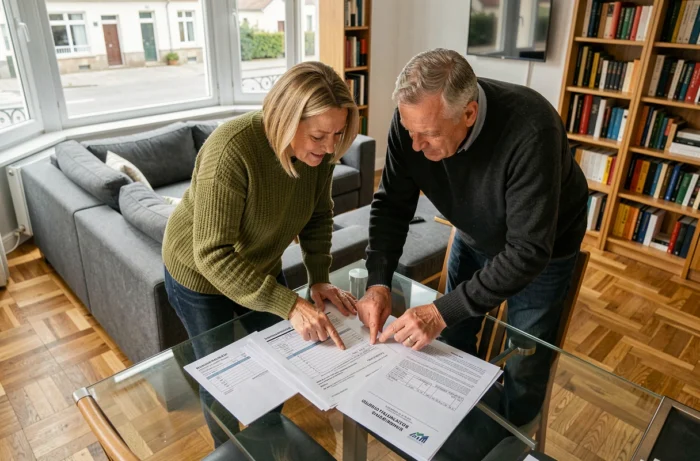
Using DVF prices to estimate the value of a house in your neighborhood
Having access to past transactions is not enough if you don’t know what to do with it. Here’s a concrete method to turn this data into a useful estimate.
- Identify three to five comparable house sales (area, number of rooms, type of land) within a close radius, ideally in the same cadastral section or neighborhood.
- Check the dates of these sales: a transaction over three years old weighs less than a recent sale in a moving market.
- Calculate an average price per square meter from these sales, excluding extreme values (sales between family members, atypical properties).
- Compare this average price to the median communal price available in the aggregated datasets by municipality, to situate your neighborhood in relation to the local average.
This approach does not replace a professional estimate, but it provides a rough idea based on actual transactions. Cross-referencing at least three comparable sales reduces the risk of relying on an isolated case.
Filtering atypical sales
Some transactions recorded in DVF skew the analysis if not identified. Sales in life annuities, transfers between relatives at reduced prices, or mixed lots (house plus agricultural land sold as a block) show amounts that do not reflect the free market. When a price per square meter seems abnormally low or high compared to neighboring sales, it’s better to set it aside.
The actual sale price of a house near you can be found in just a few minutes using public tools. The data is reliable because it comes directly from notarial deeds. The only precaution is to keep in mind the time lag and the net seller nature of the displayed amount, to avoid comparing figures that do not measure the same thing.