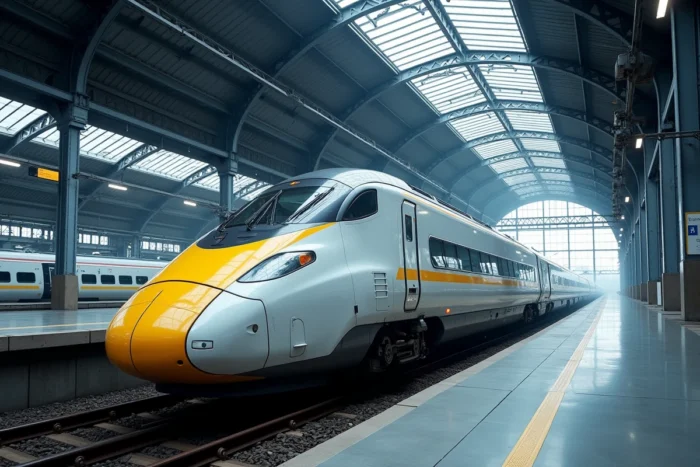
Eurostar and TGV do not operate under the same regulatory category, even though both run on French high-speed lines. The former is the only rail operator that crosses the British border via the Channel Tunnel. The latter remains confined to the continental network, without immigration control or specific documentary requirements.
Understanding what separates these two services allows for a choice between a direct journey and a TGV + Eurostar combination, two options that do not involve the same constraints.
ETA and border controls: what changes on the Eurostar segment
The Eurostar segment is the only part of the journey subject to entry formalities in the UK. Since April 2, 2025, European travelers must have an Electronic Travel Authorization (ETA) to board. This requirement is in addition to the passport, which has been mandatory since Brexit.
The ETA is requested online, with a processing time of up to three days. It conditions access to the train, not just entry onto British soil. In other words, without a valid ETA, boarding is denied at the station.
A TGV from Paris to Lille or Lyon to Paris does not require any identification documents for boarding. No immigration checks, no dedicated security line. For those preparing for the Eurostar TGV duel, this documentary asymmetry is the first criterion to consider in planning.
Eurostar also requires the transmission of Advance Passenger Information (API): full name, passport number, nationality. This information must be provided at the time of booking or at the latest before check-in. The TGV does not require anything comparable, even on international routes to Belgium or Germany within the Schengen area.

Eurostar and TGV rolling stock: trains designed for distinct missions
The Eurostar e320 (Siemens Velaro) and the older TGV TMST share a gauge compatible with the Channel Tunnel, but their specifications differ on several structural points.
- Eurostar trains are pressurized for tunnel passage, with enhanced fire safety standards (M1 materials, compartmentalization, specific emergency exits for long tunnels).
- The TGV TMST (Trans Manche Super Train), derived from the TGV Réseau, was designed from the outset for the tunnel. These trains, gradually replaced by the e320, had two independent locomotives allowing for the evacuation of half a train in case of an incident.
- Classic TGVs (Duplex, InOui) are not approved for the Channel Tunnel. Their ventilation system, gauge, and fire standards do not meet the requirements of the Intergovernmental Commission of the tunnel.
This technical constraint explains why no TGV InOui services London. The tunnel imposes specifications that only Eurostar rolling stock meets.
TGV + Eurostar combination: pricing and connections
For travelers departing from Lyon, Marseille, Bordeaux, or Strasbourg, the journey to London involves a connection in Paris or Lille. This combination raises questions that mainstream articles rarely address.
First point: TGV and Eurostar tickets are two separate bookings. SNCF Connect sometimes offers a combined fare, but most journeys require two separate purchases. In the event of a delay of the TGV, Eurostar has no obligation to hold the departure or rebook the traveler on a later train.
Second point: the change of station in Paris. TGVs coming from the south or east arrive at Gare de Lyon or Gare de l’Est. Eurostar departs from Gare du Nord. The transfer between stations takes time, and you must also factor in the security and border checks specific to Eurostar. Allow at least one and a half hours between the arrival of the TGV and the departure of the Eurostar.
Third point: the baggage policy differs. TGV InOui allows two carry-on bags and one cabin bag without weight restrictions. Eurostar limits baggage to two pieces per passenger, with stricter maximum dimensions. Non-dismantled bicycles are not accepted on Eurostar or most TGVs, unless a specific reservation for a dedicated space is made.

Eurostar fares to London: a pricing structure without TGV equivalent
The pricing structure of Eurostar does not operate like that of TGV InOui. Eurostar offers three classes of service (Standard, Plus, Premier) with significant price differences.
In Standard, the starting prices are comparable to those of a long-distance TGV, but the actual average is significantly higher, especially during peak times or less than two weeks before departure. The Premier class includes a meal served at the seat and access to the lounge at the station, a level of service that first-class TGV does not offer.
A direct comparison of Eurostar and TGV fares only makes sense if the total cost of the combined journey is included. A direct Paris-London Eurostar costs less than a Lyon-Paris TGV + a Paris-London Eurostar booked separately. The combined ticket, when available, narrows the gap but remains more expensive than a low-cost flight on the same route.
Eurostar’s yield management applies more pronounced price variations than those of the TGV. The cheapest tickets sell out several months before departure, with availability dropping rapidly during Friday evening and Sunday afternoon slots.
The choice between a direct Eurostar and a TGV + Eurostar combination therefore depends on three variables: the overall budget, the tolerance for connection risk, and the level of administrative formalities that the traveler is willing to manage in advance.