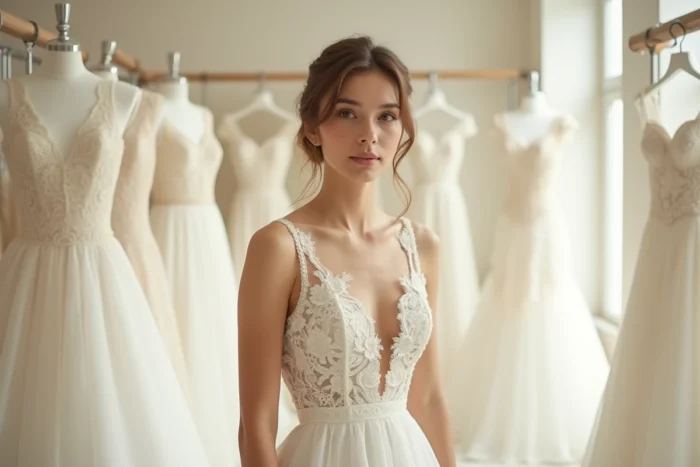
A Tati wedding dress stands out with a precise positioning: offering current cuts at accessible prices, without going through designer collections. For the 2024 season, the models available in stores or online incorporate several current stylistic codes, filtered by a budget constraint that guides choices of fabric, finishing, and silhouette.
Spotting a trendy Tati dress without following designers
The classic reflex is to consult haute couture shows to identify the current silhouettes, then look for their accessible versions. With Tati, the logic works in reverse: the models are designed from visual codes already established in ready-to-wear bridal fashion, allowing for a trendy result without relying on a fashion house.
To assess whether a Tati 2024 dress captures the right lines, three visual markers are sufficient. The first concerns the fluidity of the drape: very structured silhouettes, like voluminous princess styles, are giving way to cuts that are closer to the body or slightly flared.
The second pertains to the simplicity of embellishments: fewer heavy embroideries, more play with materials (satin, crepe, smooth tulle). The third relates to color, with a less uniform white and more frequent ivory or champagne shades.
The Tati 2024 wedding dress trends reflect this framework, where the relationship between cut, fabric, and price replaces a designer’s signature as the selection criterion.
Minimalist silhouette and clean cut: the dominant style in 2024
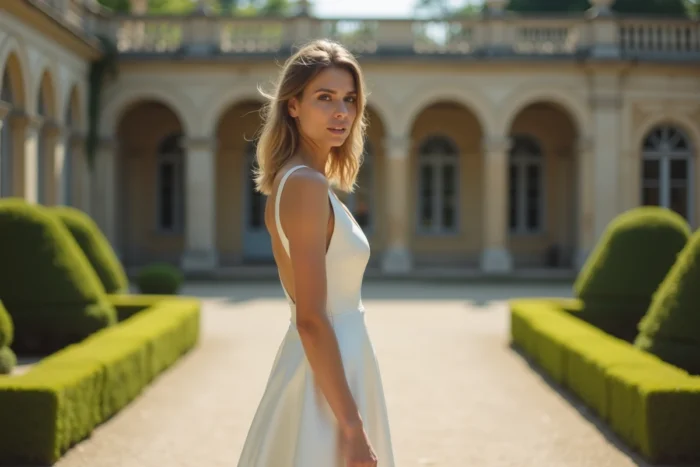
Chic minimalism emerges as the most visible direction in recent bridal collections, including those from budget brands. Fluid dresses, without excessive layering of lace or tulle, are gaining ground because they meet a concrete demand: the ability to wear the dress again after the ceremony, in another context.
At Tati, this trend translates into models made of crepe or lightweight satin, featuring straight or slightly fitted lines at the waist. The absence of a dramatic train and the simplicity of necklines (boat neck, thin straps, discreet back) reinforce this orientation.
Defined waist and structured bodice
The rise of visible corsets and sculpted bodices in recent bridal trends is also found in accessible ranges. Visible boning, highlighted seams, and geometric cutouts on the bust add an architectural dimension without requiring haute couture work. On a Tati dress, this structured detail compensates for the simplicity of the fabric and gives character to an otherwise understated silhouette.
Colors and shades beyond pure white
Optical white is gradually losing its monopoly. Pastel shades and soft tones (powder pink, lavender, glacier blue) are increasingly appearing in bridal collections, including on budget-friendly models. This evolution reflects a broadening of wedding codes, where the color of the dress becomes a personal choice rather than a convention.
On a Tati budget, the advantage of slightly colored shades is twofold. First, they better mask variations in fabric quality than pure white, which reveals every flaw under strong lighting. Second, an ivory or champagne dress is easier to wear again for an evening or another ceremony.
- Powder pink works particularly well on fluid crepe cuts, adding warmth without a “costume” effect.
- Ivory and champagne remain the safest alternatives to white, compatible with most accessories and bouquets.
- Lavender or glacier blue require more attention to harmony with the venue and decor but create a memorable effect in photos.
Wedding budget and Tati dress: balancing cut and finishing
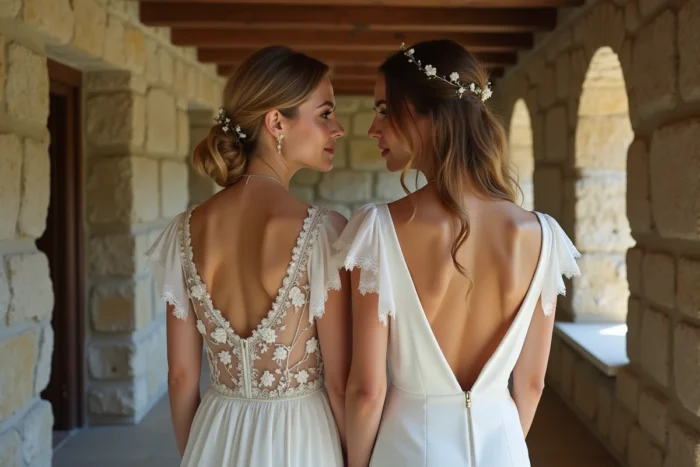
Choosing a low-cost wedding dress requires a trade-off that bridal fashion articles rarely address. The fabric and cut matter more than decorative finishes when working with a limited budget. A well-cut dress in decent crepe will always look more elegant than a model overloaded with poorly placed synthetic lace.
Three verification points allow for evaluating a Tati model in the fitting room:
- The fit of the fabric on the hips and shoulders, without any unwanted folds or gaping at the bust, remains the first indicator of quality cut.
- The interior seams should be neat and consistent, as sloppy finishes inside often signal a durability issue for the entire day.
- The comfort of movement (sitting, raising arms, walking) determines whether the dress will withstand a full ceremony followed by a reception.
Alterations: a budget to plan for
A Tati dress purchased in standard size almost always requires alterations. Planning a budget for alterations equivalent to a significant fraction of the dress price avoids unpleasant surprises. A hem, a size adjustment, or a strap alteration by a skilled tailor can transform a generic model into a personalized dress.
The most cost-effective option remains to choose a model that is slightly too large rather than too small: taking in a dress costs less and yields a better result than trying to let it out.
Choosing a Tati wedding dress in 2024 relies on a pragmatic reading of current codes, applied to a price range that excludes luxury finishes but not elegant cuts. The fluid silhouette, slightly off-white shades, and attention to alterations form a more reliable triptych than the search for spectacular low-cost embellishments.