A garden that remains in bloom from January to December does not rely on an accumulation of varieties, but on a relay logic between flowering periods. Since the regulations have prohibited individuals from using chemical pesticides in their ornamental spaces, the choice of flowers and maintenance methods have changed fundamentally. Creating a vibrant garden year-round requires a different approach to plant selection, soil preparation, and pest management.
Garden maintenance without phytosanitary products: what the law requires
Since January 1, 2019, individuals can no longer purchase, use, or store chemical pesticides for maintaining their gardens. Only biocontrol products, low-risk products, and those usable in organic farming remain authorized.
A decree from January 15, 2021, strengthened this framework. Since July 1, 2022, all phytopharmaceutical products outside these three categories are prohibited in private properties for residential use, including ornamental spaces. This ban also applies to professional landscapers working in private gardens.
This regulatory constraint has a direct consequence on the design of a flowering garden. The chosen plants must resist diseases and pests without resorting to chemicals. This encourages the selection of robust perennials, local species adapted to the region’s climate, and nectar-rich plants that attract natural predators.
The use of mulching, manual weeding, and biocontrol solutions is no longer an option among others: it is the only legal approach. The catalogs of flowers on the Info Jardinage website allow filtering varieties according to these criteria of hardiness and adaptation.
Soil and exposure: the two variables that determine flower selection
Before selecting any plant, two parameters condition the success of the garden. The first is soil texture. Clay soil retains water and is suitable for astilbes or daylilies. Sandy, well-draining soil favors lavenders, gauras, and most Mediterranean plants. Calcareous soil points towards peonies, irises, and clematis.
Analyzing soil texture before any planting avoids the majority of failures. A simple test involves taking a handful of moist soil and squeezing it. If it forms a compact ball, the soil is clayey. If it crumbles, it is sandy. Between the two, loamy soil offers the greatest versatility.
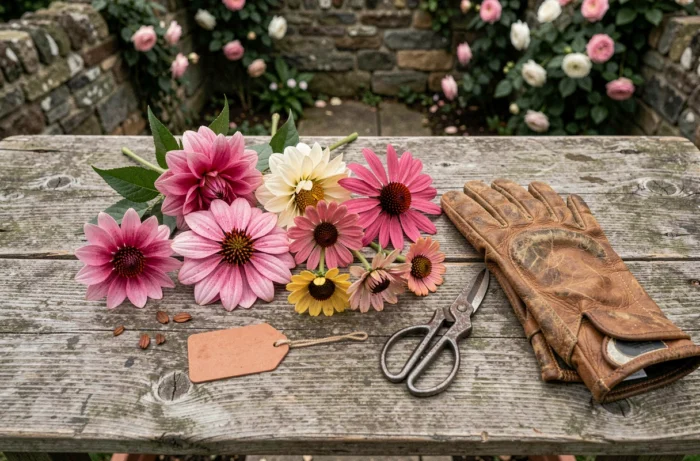
The second parameter is exposure. A flowerbed facing south will not host the same species as a permanently shaded area. Perennials like hostas or ferns thrive in the shade, while rudbeckias and echinaceas require full sun. Mapping out shaded and sunny areas throughout the day allows for planting distribution without unpleasant surprises.
Staggered flowering: building a relay calendar between perennials and shrubs
The key to a colorful garden year-round lies in the succession of bloom periods. The idea is not to plant as many species as possible, but to ensure that at every time of the year, at least two or three groups of plants are flowering simultaneously.
From spring to summer
Bulbs kick off the season as early as the end of winter: snowdrops, crocuses, daffodils, and then tulips. These bulbs are planted in the previous autumn and require almost no maintenance. They take over from winter blooms and make way for spring perennials like perennial geraniums, lupines, and peonies.
In summer, echinaceas, gauras, agapanthus, and salvias take the lead. Summer-flowering shrubs (buddleia, hydrangea) complement the beds by adding volume.
From autumn to winter
Autumn is the most neglected season in planning. Asters, Japanese anemones, and sedums extend colors until the first frosts. The sasanqua camellia blooms as early as October and ensures the transition to winter, a period when hellebores (Christmas roses) and winter heathers maintain floral presence.
Some shrubs with decorative bark or colorful berries (dogwood, callicarpa) compensate for the scarcity of winter blooms with a different visual interest.
Maintenance without pesticides: actions that replace chemistry
A garden designed with plants suited to the soil and local climate significantly reduces the need for intervention. Field reports vary on the effectiveness of certain alternative methods, but several practices are widely agreed upon among landscape professionals.
- Organic mulching (wood chips, straw, dead leaves) limits the growth of weeds, retains soil moisture, and nourishes microbial life as it decomposes. A sufficiently thick layer applied in spring and topped up in autumn covers most weeding needs.
- Pruning perennials after flowering stimulates regrowth in certain species (perennial geraniums, nepeta) and prevents the plant from exhausting itself producing seeds.
- Grouping nectar-rich plants (lavender, borage, phacelia) attracts pollinators and natural predators of aphids, reducing pest pressure without any inputs.
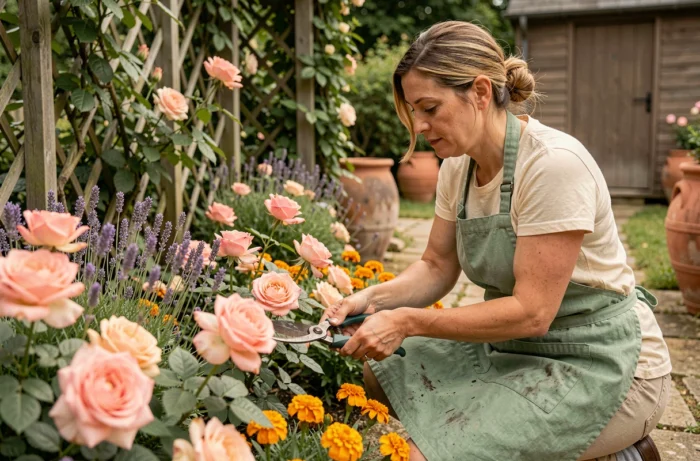
- Manual weeding remains the only legal method for eliminating unwanted plants in a private garden, aside from mulching and approved biocontrol solutions.
Watering also deserves special attention. Watering in the morning at the base of the plants (and not on the foliage) limits the development of fungal diseases. During dry periods, well-established perennials for two years or more withstand drought significantly better than recent plantings, which advocates for patience during the initial seasons.
Ultimately, designing a garden that blooms year-round comes down to intersecting three perspectives: the regulatory framework that excludes chemicals, the characteristics of the land that guide species selection, and a flowering calendar conceived as a relay. The plants best suited to the soil and local climate are also those that require the least maintenance, simplifying management throughout the seasons.