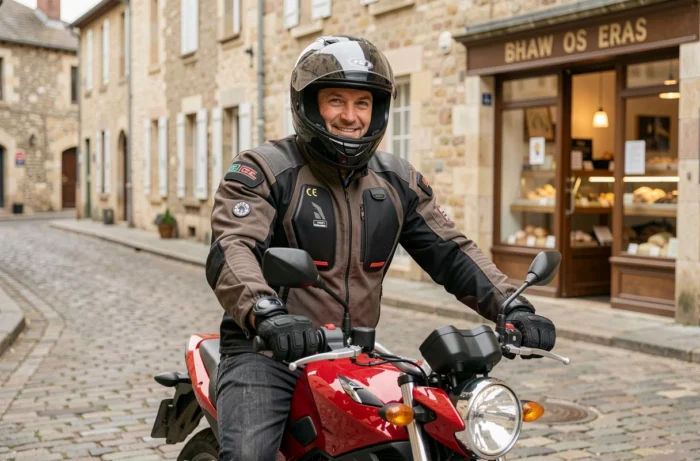
The B license allows for the operation of a 125 cc motorcycle in France, but not automatically. Two cumulative conditions govern this access: a minimum age of the license and mandatory practical training. These rules, often summarized in a vague manner, deserve to be detailed point by point, especially since the category of the vehicle (two-wheeled or three-wheeled) changes the obligations.
125 cc Motorcycle and L5e Three-Wheeled Scooter: Two Distinct Regimes with the B License
A common misconception is to group all two-wheeled and three-wheeled motor vehicles accessible with the B license under the label “125.” However, the Service-Public website distinguishes between two well-separated cases: the light motorcycle 125 cc on one side, and the L5e category three-wheeled scooter on the other.
The light 125 motorcycle corresponds to a two-wheeled vehicle whose engine capacity does not exceed 125 cc and whose power is limited to 11 kW. The L5e three-wheeler (such as the Piaggio MP3 or Peugeot Metropolis) adheres to different weight, wheelbase, and power criteria.
In both cases, the B license grants access to driving, but the conditions of age and training apply. Confusing the two categories can pose problems during a check or an insurance declaration, as the vehicle must correspond to the category mentioned on the training certificate.
For detailed regulatory information, the conditions for the 125 cc license on Auto l’Hebdo summarize the obligations applicable to each type of vehicle.
Age of the B License and 7-Hour Training: The Two Cumulative Conditions
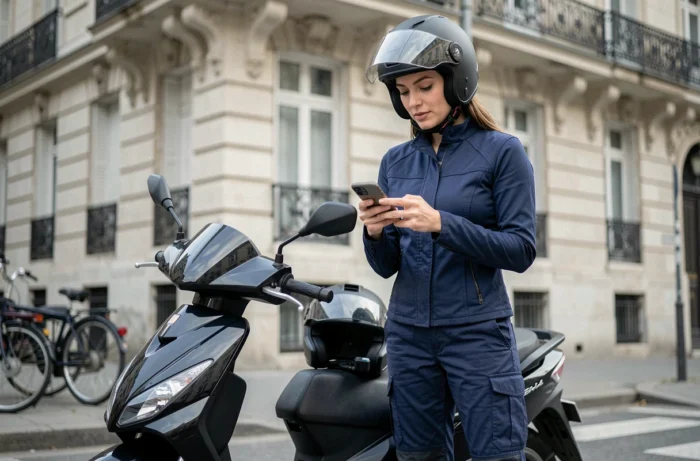
The legal framework sets two simultaneous requirements. The first: to have held the B license for at least two years. The second: to have completed a 7-hour practical training course provided by an accredited driving school.
This training can be taken in the month preceding the two-year anniversary of the B license. In other words, a driver who obtained their license on September 15 can start the training as early as August 15 of the second year.
Exemptions from Training
Three situations allow for not taking this training:
- The B license was obtained before March 1980 (it then includes an A1 equivalence by right).
- A practical training of 3 hours was completed before 2011, which exempts from retaking the 7-hour training.
- The driver has indeed operated a light motorcycle or an L5e three-wheeled scooter between 2006 and 2010 while holding the B license for at least two years at that time.
Holders of a B license issued by another European country do not benefit from these exemptions and must necessarily complete the training, even if they were already riding a 125 in their home country.
Concrete Content of the 7-Hour Training for the 125 Motorcycle
The training is divided into three complementary modules, without a final exam. No graded test penalizes this day: the certificate is issued as soon as the 7 hours are completed.
The first two hours focus on theory. They cover awareness of the specific risks associated with two-wheeled and three-wheeled vehicles, the blind spots of heavy vehicles, and accident statistics specific to light motorcycles.
Two hours of off-road practice follow, on a training area. The driver learns to control the machine at a slow pace: starting, braking, slalom, U-turns. This is often the most destabilizing part for a motorist who has never ridden a two-wheeler.
The last three hours take place in real traffic. The instructor guides the trainee via a radio system, under normal road conditions. These hours serve to acquire the reflexes of positioning on the road, managing intersections, and using mirrors.
Certificate and Proof
At the end of the training, the driving school issues a training completion certificate. This document must be kept and presented in case of a road check. It is not directly inscribed on the driving license: it is a separate document, often in paper or digital format depending on the institution.
Comparison with the German B196 Regime: A Significant Difference
France is not the only European country that allows driving a 125 with a car license, but the conditions vary significantly from one state to another. Since 2020, Germany has implemented a system called B196 code, which differs significantly from the French system.
The German B196 requires a minimum age of 25 (compared to no specific age in France beyond the two years of license), five years of holding the B license (compared to two in France), and nine units of theoretical and practical training, also without a final exam.
A major difference: the B196 does not provide any recognized A1 equivalence outside of Germany. A German driver holding the B196 cannot legally ride a 125 in France with this code alone. Conversely, the French 7-hour training certificate is only valid on national territory and in certain countries that have signed reciprocity agreements.
This distinction is of direct interest to cross-border commuters, expatriates, or travelers considering renting a 125 abroad. Checking the validity of one’s license in the country of circulation is essential before hitting the road.
The cost of the training varies according to driving schools and regions but remains significantly lower than obtaining a full A1 license, which involves a theoretical and practical exam with both off-road and on-road components. For a motorist who simply wishes to access two-wheeled mobility without retaking a full license, the 7-hour training remains the most direct route, provided the two criteria of age and effective completion of the training are met.