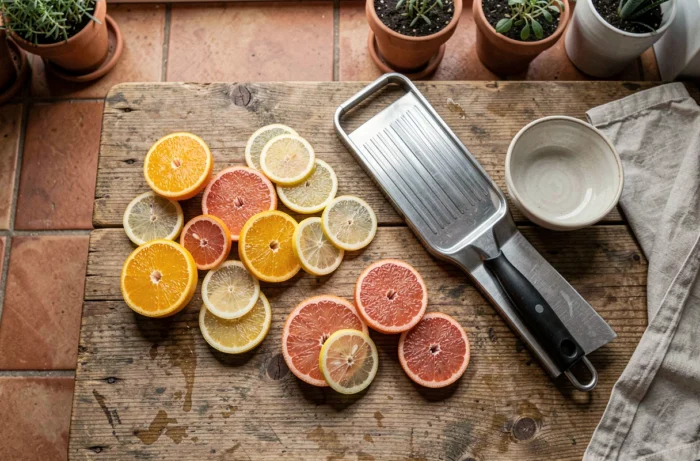
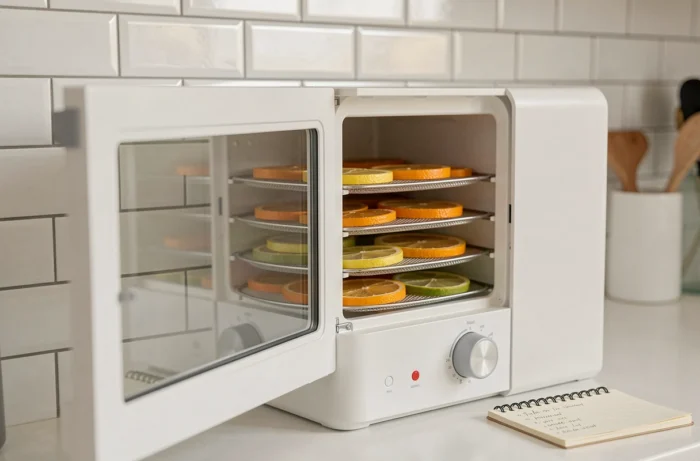
A food dehydrator removes the water contained in citrus slices by circulating warm air at low temperatures. The result depends less on the recipe than on two physical parameters: the thickness of the cut and the level of dehydration actually achieved in the fruit. If not properly controlled, these parameters produce soft slices that mold within a few days.
Water activity in dried citrus: the benchmark that recipes overlook
Tutorials refer to “dry” or “crunchy” slices, but the true indicator of success is water activity, noted as aw. This coefficient measures the free water available for microbial growth in a food.
Below an aw of about 0.91, the main pathogenic bacteria no longer grow. Below 0.88, most yeasts are inhibited. Below 0.80, common molds stop, and below 0.70, the product achieves long-term shelf stability.
For citrus intended to be stored for several months, aiming for an aw below 0.70 remains the safest target. In practical terms, this means the slice must be rigid, brittle when bent, with no soft area in the center. A fruit that still bends without breaking contains too much free water for room temperature storage.
When you want to dehydrate citrus in a dehydrator, this concept of water activity changes the way to evaluate the result: the tactile test replaces the timer.
Cut thickness and albedo: preparing uniform citrus slices
The thickness determines the drying time and the final appearance. Slices that are too thin brown quickly and stick to the trays. Slices that are too thick dry on the surface while the center remains moist, leading to invisible mold after storage.
The effective range is around 3 to 5 mm. A sharp knife is sufficient, but a mandoline ensures a consistency that the hand cannot reproduce over twenty consecutive slices.
The specific problem of thick albedo
Albedo, the spongy white part between the peel and the pulp, varies among citrus fruits. Grapefruits and some lemons have a very thick albedo that dries much more slowly than the pulp. On the same slice, two areas with different drying speeds coexist.
Partially removing the albedo with a peeler before slicing solves this problem for varieties with thick skin. For navel oranges or clementines, the thin albedo does not pose any particular difficulty.
- Navel oranges, blood oranges, clementines: thin albedo, slice directly with the skin without additional preparation
- Grapefruits, pomelos, thick-skinned Meyer lemons: trim the albedo with a knife or peeler to reduce the drying gap between the center and the periphery
- Classic yellow lemons, limes: medium albedo, cut into slightly thinner slices to compensate
Temperature and drying time in the dehydrator for citrus
The dehydration of citrus works at low temperatures. Going above 65-70 °C caramelizes the surface sugars and gives a bitter taste, especially on orange and grapefruit.
A temperature between 50 and 57 °C is suitable for most citrus. The duration varies depending on the thickness, the initial moisture content of the fruit, and the ventilation capacity of the device. Expect between six and twelve hours for 4 mm slices, more if the dehydrator is fully loaded.
Tray rotation and airflow
On vertical stack dehydrators, warm air circulates from the bottom to the top. The lower trays dry faster. Switching the order of the trays halfway through (after three to four hours) equalizes the result.
On horizontal flow models, the difference between trays is less significant. Rotation remains useful but is less critical. In both cases, do not stack the slices or let them overlap: each slice needs direct contact with the air on both sides.

Storage of dehydrated citrus: container, light, and duration
Once the slices have cooled to room temperature (wait at least thirty minutes outside the dehydrator), storage conditions determine the longevity of the product.
- Hermetic glass jars, protected from direct light: preserve aromas and protect from ambient moisture
- Zip bags with the maximum air expelled: practical solution, but less durable if the seal is not perfect
- Opaque metal boxes: good protection against light, suitable for large quantities
The main enemy remains residual moisture in the container. If a single slice is insufficiently dry, it can rehydrate the others. Checking each slice individually before storing limits this risk.
Cold storage (in the refrigerator or in a cool cupboard) extends shelf life. Properly dried slices down to a low aw can last several months without visible alteration or significant loss of aroma.
Uses range from table decoration to infusions, as well as additions to pastries or cocktails. Dried lemon slices flavor tea without the bitterness of fresh zest. Orange slices add a concentrated sweet note to a cake or mulled wine. Whatever the use, the quality of the initial drying determines the final result much more than the choice of recipe.