
The term vintage refers to an object made between twenty and one hundred years before the current date. The word retro, on the other hand, describes a recent creation that adopts the aesthetic codes of a bygone era.
This distinction, often blurred in everyday language, influences market value, the collecting approach, and even the applicable regulatory framework. Fashion, automobiles, video games, decoration: retro and vintage culture permeates very different realms, connected by a shared attraction for forms, materials, and stories from the past.
Vintage objects and retro creations: a boundary that changes everything
A piece of furniture produced in the 1960s is vintage. A shelf made in 2025 with lines and colors inspired by the Scandinavian design of the sixties is retro. The nuance may seem slight, but it determines the price, rarity, and purchasing approach.
A vintage garment features finishes, fabrics, and cuts that no longer exist in current production. Its value is based on authenticity: period label, consistent wear, traceable provenance. Retro, however, borrows a visual vocabulary (saturated colors, rounded typography, geometric patterns) without claiming to be old.
Both registers coexist in the same spaces, from thrift stores to specialized salons, and feed off each other. A retro creator draws inspiration from vintage originals to design a collection; a vintage collector relies on the media visibility of retro to enhance their pieces. Resources like retrorevue.fr document this ongoing circulation between authentic past and contemporary reinterpretation.

Pop culture and retro gaming: why the nostalgia of the 1990s dominates
The current nostalgic wave primarily targets the 1990s and the early 2000s, a period referred to as Y2K. Mainstream brands are re-launching lines of clothing, sneakers, and accessories directly modeled after this decade, while the entertainment sector is multiplying reboots of series and video games.
Retro gaming illustrates this dynamic in a concrete way. Vintage consoles (cartridges, wired controllers, cathode-ray screens) have become collectible items whose value is steadily rising. At the same time, publishers are marketing mini-consoles preloaded with games and digital compilations that replicate the gaming experience without requiring old hardware.
The appeal extends beyond individual nostalgia. Events, workshops, and associations organize retro gaming sessions open to children and families, transforming a solitary hobby into a collective spectacle. Pixel art, a graphic language born from the technical constraints of early consoles, has become a fully-fledged artistic movement, exhibited in galleries and used by contemporary artists.
European regulation and the vintage market: what is changing for collectors
Two recent regulatory developments are altering the conditions under which retro and vintage objects circulate in Europe.
Classic vehicles and regulations on end-of-life vehicles
Regulation (EU) 2026/1738 mandates that, starting September 1, 2031, only vehicles declared fit for circulation can be exported outside the European Union. Electronic traceability via the MOVE-HUB platform will accompany this requirement.
Very old, damaged, or incomplete vehicles will no longer be able to leave the EU for restoration elsewhere. This restriction is expected to strengthen the supply of collectible cars and spare parts in the European market, encouraging enthusiasts to restore locally rather than export to third countries.
Tax thresholds for occasional resale
A European project aims to eliminate the 30 transaction criterion and raise the single transmission threshold to 3,000 euros per year, which would remove about 11.3 million sellers from the tax declaration scope. For small occasional resellers (flea markets, one-off sales of clothing, decorative items, games), this simplification secures resale without additional reporting obligations.
These two texts outline a framework where the European vintage market is becoming more structured: enhanced traceability on valuable goods, reduced administrative burden on modest transactions.
Vintage decoration and art of living: trends that are taking hold
Interior decoration absorbs vintage culture in successive waves. Following the return of mid-century furniture (hairpin legs, light wood, organic shapes), the current trend is turning towards interiors inspired by grandparents’ homes: embroidered tablecloths, mismatched crockery, floral wallpapers, patinated brass lighting fixtures.
- Antique textiles (crochet, macramé, raw linen) replace smooth synthetic materials in living spaces, bringing a texture that contemporary industrial production struggles to replicate.
- Reclaimed furniture (buffets, farmhouse tables, club chairs) integrates into modern interiors as a unique character piece, breaking away from standardized furnishings.
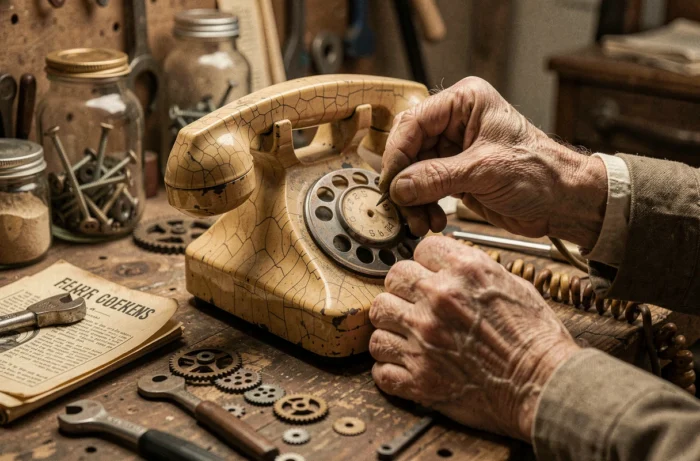
- Vintage decorative objects (advertising posters, wall clocks, rotary phones) serve as focal points in a room, playing a role comparable to that of a work of art.
This approach aligns with sustainability concerns. Reusing an existing piece of furniture avoids the production of a new one, with all the implications in terms of resources and transport. The European directive on the sustainability and reparability of products reinforces this logic by encouraging repair over replacement.
Workshop, creation, and transmission: retro culture as a living practice
Retro culture is not limited to acquiring objects. It generates an ecosystem of workshops, training, and manual practices. Vintage sewing, furniture restoration, repairing tube radios: these technical skills are passed down in community workshops and during specialized events.
The restoration work, whether on a garment or a vehicle, mobilizes artisanal skills that mass production has marginalized. The associations that run these workshops fulfill a mission of cultural preservation as well as practical training.
The geek universe participates in the same movement. Restoring an arcade machine, refurbishing a console, recreating a game cartridge: these activities blend electronics, programming, and design in a playful setting that attracts both seasoned enthusiasts and families seeking shared manual activities.
Retro and vintage culture functions as a filter applied to the present. It does not reproduce the past identically but selects forms, materials, and methods that meet current expectations of uniqueness, sustainability, and social connection. The European regulatory framework, by structuring the circulation of old objects and occasional resale, supports this evolution without hindering it.