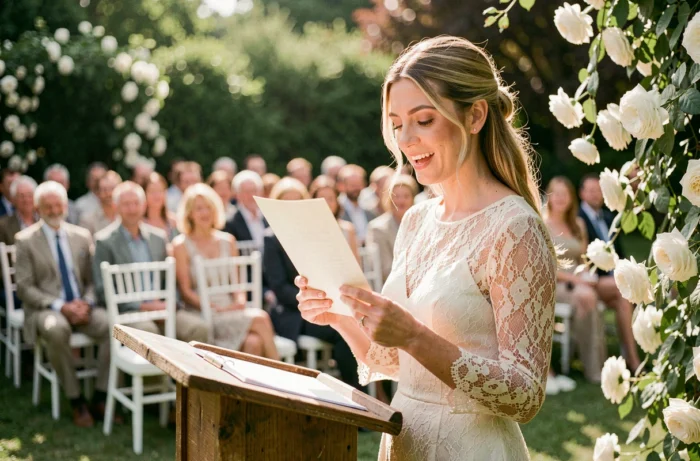
During a wedding ceremony, the choice of a text to read aloud involves much more than just a question of literary taste. The format of the ceremony (civil, secular, religious) determines what can be read, by whom, and at what moment.
The secular wedding, which remains a symbolic commitment without its own legal framework in France, offers complete freedom regarding readings. The civil ceremony requires the reading of certain articles from the Civil Code by the civil registrar. Between these two frameworks, the constraints diverge, and the chosen text will not have the same role or impact.
Secular or civil ceremony: what the legal framework changes for your wedding readings
The distinction between civil ceremony and secular ceremony is not trivial for the choice of texts. Only civil marriage produces legal effects in France. The secular ceremony, on the other hand, has no official recognition or registry: it is a moment of free celebration, organized according to the couple’s wishes.
At the town hall, the civil registrar is required to read articles from the Civil Code relating to the rights and duties of spouses. A bill submitted to the Senate in July 2026 (PPL n°927) aims to make the reading of certain provisions related to parenthood optional during the celebration. If this text comes to fruition, civil ceremonies would gain flexibility, but at this stage, the constraint remains in effect.
In a secular ceremony, there is no such obligation. The couple freely chooses literary excerpts, poems, or personal texts. This latitude explains the growing popularity of this format for couples wishing to personalize their union. To find beautiful texts for weddings to read in this context, one must first identify the exact format of their ceremony.
Duration and reading pace: a selection criterion often underestimated
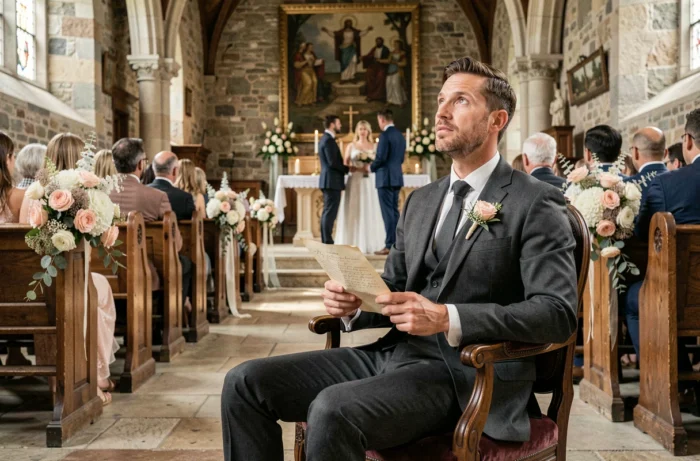
Most online compilations offer dozens of texts without addressing a crucial practical point: the recommended reading duration is two to three minutes per text. Beyond that, the guests’ attention wanes, and the text loses its emotional effect.
This time constraint has direct consequences on the choice. An excerpt from a three-page novel, no matter how beautiful, does not work well orally in a ceremony that features multiple interventions. Short texts, between fifteen and thirty lines, are the most effective.
How to calibrate a text for oral delivery
Reading a text silently and reading it aloud in front of an audience are two different experiences. The average oral delivery speed is slower than silent reading, and natural pauses (emotion, breathing) extend the actual duration.
- Time the reading aloud at least twice before the big day, in conditions close to reality (standing, at a speaking volume).
- Prepare a printed version in large font, with visual cues for pauses, rather than a phone screen that is difficult to read under outdoor lighting.
- If multiple readings are planned, alternate a short text (one minute) and a more developed text (two to three minutes) to maintain the rhythm of the ceremony.
A beautifully crafted text that is poorly calibrated produces less effect than a simple text well delivered. The form of the reading matters as much as the content.
Poems, prose, songs: which literary register for which moment of the ceremony
Online competitors often classify texts by author or theme. The approach by literary register is more operational, as each format serves a different function in the flow of the ceremony.
The poem: intensity and conciseness
The poem works well at the opening or closing of a secular ceremony. Its natural brevity respects the time constraint. Paul Éluard, Louis Aragon, or Robert Desnos are reliable choices from the Francophone repertoire, often cited in existing compilations.
However, contemporary free verse poetry can unsettle an unaccustomed reader. Favoring a text with a regular rhythm facilitates reading aloud and limits hesitations.
Literary prose: depth and narration
An excerpt from a novel or correspondence (Victor Hugo to his wife, Antoine de Saint-Exupéry in “The Little Prince”) adds a narrative dimension absent from poetry. This format fits well in the heart of the ceremony, between the exchange of vows and the symbolic rituals.
The difficulty lies in the excerpting: taking a passage out of its novelistic context can alter its meaning. Ensure that the excerpt stands on its own, without requiring prior explanation for the audience.
The song text: a register to handle with care
Jacques Brel, Ginette Reno, or English-speaking artists like the Arctic Monkeys are sometimes suggested as readings. A song text devoid of its melody loses part of its power. The lyrics that work well orally are those whose structure remains solid without the music, which excludes many repetitive choruses.
Personal text or author’s text: the criteria to decide
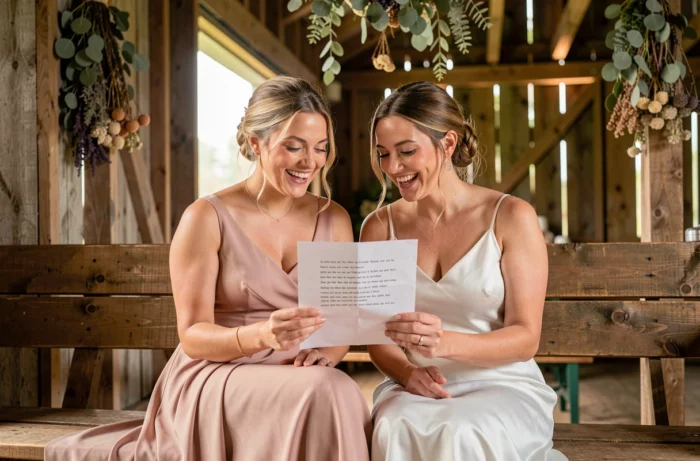
Writing your own text is tempting, but not all couples have the same writing ease. The question is not whether a personal text is “better” than an author’s text. It is about what will be most appropriate orally, in front of an audience.
- A personal text works when it tells a specific moment of the couple, not when it accumulates general statements about love. Specificity creates emotion.
- An author’s text works when the reader has made it their own, has read it aloud several times, and can deliver it with conviction without stumbling over the vocabulary.
- Combining both (a passage from an author framed by a few personal sentences) is an option that allows one to rely on a solid structure while adding an intimate touch.
Field feedback varies on this point: some officiants of secular ceremonies find that personal texts read by a close friend touch the audience more, while others report laborious readings due to insufficient preparation.
The most reliable criterion remains repetition. A text repeated five times aloud before the ceremony will always be more moving than a text discovered the day before, regardless of its author. The preparation of the reading deserves as much attention as the choice of the text itself.