
The major online recipe platforms list several tens of thousands of preparations, but most households operate with a rotation of about ten dishes, often the same ones week after week. The issue isn’t a lack of delicious recipes, but understanding what drives the tendency to cook the same things and what allows, concretely, to refresh meals without turning every dinner into a project.
Micro-seasons and ingredients: what fine seasonality changes on the plate
The so-called “living cuisine” trend, documented in gourmet dining in 2026, is based on a simple principle: exploiting micro-seasons. While most amateur cooks think in terms of four seasons (tomatoes in summer, squash in autumn), micro-seasons break each period into windows of a few weeks during which a product reaches its peak flavor.
Applying this logic to everyday cooking means changing the main ingredient almost every two weeks. A roasted chicken served with fresh peas in early June has a different profile than with coco beans at the end of July. The dish remains the same; only the accompaniment changes with the season.
This approach requires visiting markets or short supply chains more regularly, which takes time. Some households find it simplifies things (fewer choices = less hesitation), while others see it as an additional logistical constraint. The flavor gain, however, is hardly debatable. A vegetable picked at maturity and cooked in the following days has much more flavor than a product calibrated for transport.
Among French-speaking resources that compile meal ideas around seasonal products, gastronomiedujour.fr offers an entry by ingredient that facilitates this type of rotation.
Delicious recipes and visual trends: the impact of social media on our choices
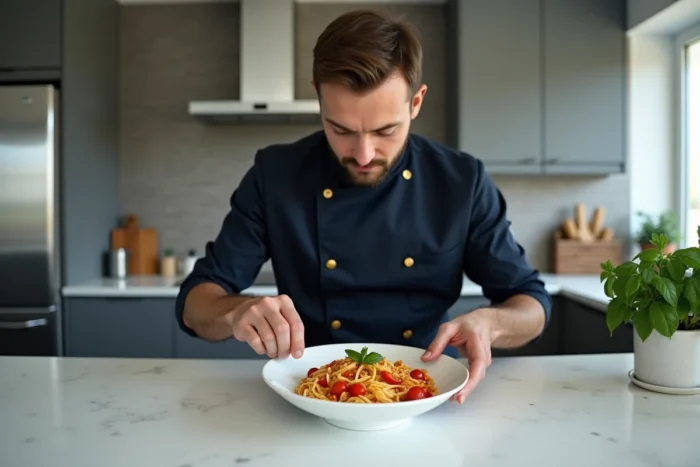
The most shared recipes in 2026 are not necessarily the most flavorful. They are the most photogenic. Sushi cake, cloud coffee, and Dubai chocolate circulate massively on Instagram and TikTok. These preparations prioritize visual effect (texture, color, spectacular gesture) and are designed to be easily replicated at home.
Gourmet cooking shifts towards the spectacular and playful. A New York roll filmed in fast motion generates more engagement than a veal blanquette, even if the latter requires more technique. This gap between online popularity and culinary relevance deserves to be noted.
A real contribution, but limits for everyday cooking
The positive side: they bring people to cooking who might not have come otherwise. Reproducing a dessert seen on TikTok can spark the desire to cook beyond the viral recipe.
The limit: these recipes often rely on processed or imported ingredients (premium spread, industrial stuffed chocolate) and do not fit into a rotation of daily meals. They function as one-off events, not as a repertoire.
Building a repertoire of dishes rather than accumulating recipes
The difference between a cookbook and a personal repertoire lies in ownership. A repertoire is a set of dishes that one masters enough to prepare without consulting a recipe, adapting the ingredients to what is available.
To move from passive consultation to building a repertoire, three strategies work better than a simple collection of links:
- Master versatile cooking basics: a savory tart (shortcrust pastry, free filling), a stew (protein of choice, tomato sauce or chicken stock), a gratin (seasonal vegetable, béchamel or cream). These structures accept dozens of variations without changing technique.
- Set a realistic time/pleasure ratio: a recipe that takes less than thirty minutes with a delicious result (tomato and mustard tart, lemon-marinated chicken, pasta with ham and melted cheese) establishes itself sustainably in the rotation. A dish that takes two hours will only be made occasionally.
- Vary proteins throughout the week: alternating chicken, beef, fish, and vegetarian meals prevents monotony. The taste changes, even if the structure of the dish (protein + vegetable + starch) remains stable.
A repertoire of twelve to fifteen well-established dishes covers three weeks without repetition. Adding two or three new recipes per month is enough to gradually refresh the whole.

The Nutri-Score and the reformulation of industrial recipes: a context to know
Food industry players have had to adapt their recipes to improve their Nutri-Score, which alters the composition of many basic products used in cooking (sauces, broths, prepared dishes). The available data does not allow us to conclude that these reformulations systematically improve taste. In several cases, reducing salt or sugar alters the aromatic profile of the finished product.
For everyday cooking, this means that reproducing an old recipe with the same industrial products can yield a different result. A reformulated stock cube no longer salts as much. A store-bought tomato sauce may have changed in texture. Adjusting seasoning by tasting systematically, rather than following the quantities from a recipe written a few years ago, becomes a useful habit.
Cooking from raw ingredients as a solution
Using unprocessed ingredients (fresh tomatoes, homemade stock, whole spices) removes this variable. The result then depends solely on the product and the technique. It takes longer, but the taste remains stable from one preparation to another.
Everyday gourmet cooking is not just about finding the right recipe. It relies on a personal repertoire built through practice, attention to seasonal products, and clarity about what trends truly bring to the plate. A zucchini gratin prepared for the tenth time, adjusted to the gram of salt, often holds more value than a viral recipe attempted just once.