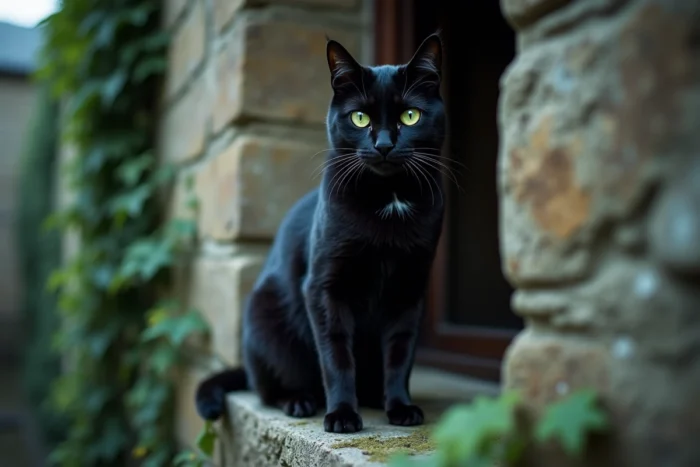
A black cat is staring at you with its green eyes from the edge of a window. Depending on your culture, this gaze evokes luck, witchcraft, or simply a beautiful feline. The black cat with green eyes crystallizes contradictory beliefs that traverse centuries and continents, none of which rest on a solid scientific basis.
Green Eyes of the Black Cat: What Genetics Says About Pigmentation
You may have noticed that most black cats have green, yellow, or copper eyes, but rarely blue? This is not a mystical coincidence. The color of the eyes depends on the amount of melanin present in the iris.
In a cat with black fur, the genes responsible for fur pigmentation also promote a moderate concentration of melanin in the iris, producing shades ranging from yellow to deep green. Blue eyes, on the other hand, result from a near absence of melanin in the iris, a trait more common in white or colorpoint cats.
The color of the eyes is a matter of genetics, not the supernatural. The angle “with green eyes” is rarely addressed in online content about black cats, which almost all focus on the fur. Understanding the meaning of the black cat with green eyes begins with this biological reality before any symbolic interpretation.
Superstitions Surrounding the Black Cat: A Geography of Beliefs
The idea that the black cat brings bad luck only concerns part of the world. In Western Europe, this belief dates back to the Middle Ages when black cats were associated with witchcraft and the devil. Women accused of witchcraft often owned cats, and the dark fur was enough to transform the animal into a symbol of black magic.
This superstition is a European medieval legacy, passed down from generation to generation without rational basis. It was then exported to the colonies, particularly in North America, where crossing paths with a black cat remains a bad omen for some.
The Lucky Black Cat in Japan and the United Kingdom
In contrast, Japanese folklore views the black cat as a messenger of luck. For single women, owning a black cat would attract good suitors. The Maneki-neko, the famous figurine of the cat raising its paw, exists in a black version to ward off evil spirits and protect against illness.
In the United Kingdom, popular tradition also reverses the omen: a black cat entering a house heralds prosperity. The same animal, with diametrically opposed interpretations depending on the country.
Interpretations in Religious Traditions
In some Islamic interpretations, the cat holds a special place. The prophet is said to have had a marked affection for felines. Esoteric interpretations vary among different currents: some associate the black cat with djinn or witchcraft, while others associate it with protection and baraka. These interpretations belong to the symbolic and religious realm, not to an observable reality.
Black Fur and Cat Behavior: What Science Says
You might think that a black cat is more distant, wilder, or more mysterious than a ginger or tabby cat? Recent research on feline behavior does not confirm any such thing.
The temperament of a cat depends on three main factors:
- Its individual genetics, related to parental lineage and not to fur color
- Its early socialization, meaning interactions with humans and other animals during its first weeks of life
- Its daily environment, including available space, stimulation, and the relationship with its owners
No study links fur color to a cat’s character. A black cat that is socialized early will be just as affectionate as a cat of any other color. The behavioral stereotypes associated with feline coats stem from confirmation bias: we observe what we expect to see.
Adoption of the Black Cat: Why Shelters Still Struggle
Superstitions have concrete consequences. In shelters, black cats are among the animals that take the longest to find homes. Several animal protection organizations regularly report this, and International Black Cat Day (celebrated every August 17) exists precisely to combat this phenomenon.
The reasons for this lack of affection are multiple:
- The persistence of superstitions, even unconscious ones, among potential adopters
- A photographic effect: on adoption sites, black cats do not stand out as well in photos as light-colored or bicolor cats, which reduces clicks on their profiles
- The fashion effect surrounding certain coats (ginger, tabby, Siamese) that captures attention at the expense of dark solid coats
The result is an overrepresentation of black cats in shelters. Choosing a cat based on the color of its fur means ignoring what really matters: its temperament, compatibility with your lifestyle, and its history.
Black Cat with Green Eyes and Contemporary Symbolism
Today, the black cat with green eyes retains a special aura in popular culture. It remains omnipresent at Halloween, in illustrations of witchcraft, and on social media where accounts dedicated to black cats gather loyal communities.
This aesthetic fascination can work in favor of the animal. The contrast between the ebony fur and the green eye shine creates a striking visual effect that appeals to many cat lovers. The visual appeal can finally serve the cause of adoption rather than superstition.
The black cat with green eyes has no supernatural power, predicts neither luck nor misfortune, and its behavior is no different from that of a cat of another color. What gives it its uniqueness lies in the genetics of its pigmentation and in the richness of the stories that humans have projected onto it for millennia. The only meaning that matters is the one you build by living with it.