When looking for a masculine name that transcends generations without aging, Antoine consistently appears on the lists. A Latin name borne by major historical figures, it has several centuries of presence in France. With around 895 births recorded in 2025, it is still assigned each year, but its recent trajectory tells a more nuanced story than that of a simple timeless classic.
Antoine and the Paradox of the Heritage Name Losing Ground
Antoine shows a 36% decline over five years according to data compiled by Mira Parent. The name was ranked 54 in 2024 according to this same source, while the Journal des Femmes estimated it at rank 48 that same year.
This erosion can be explained by a well-known mechanism among civil registry demographers: classic names saturate a generation, and then subsequent parents seek to distinguish themselves. The average age of those named Antoine is 51 years according to the Journal des Femmes, which places most of the bearers among those born before the 2000s. The peak of popularity dates back to 1996. As a result: Antoine has become the name of the father or uncle, rather than that of the newborn.
To delve deeper into the origin and popularity of this name over the decades, one can consult the name Antoine on Gloria Net, which traces its journey in France with detailed data.
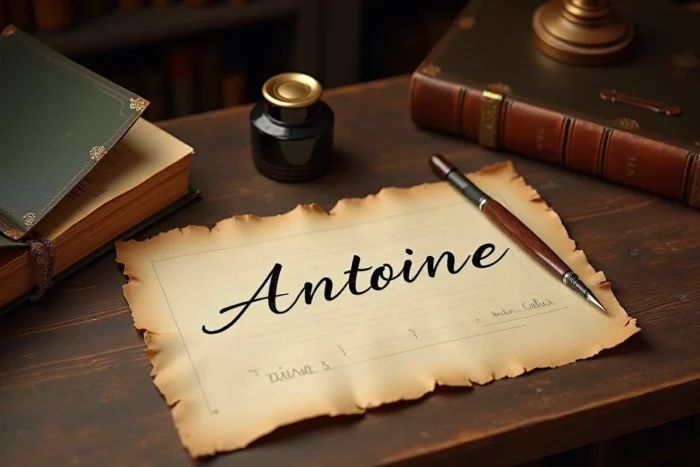
Etymology of Antoine: from Latin Antonius to International Variants
The name Antoine directly descends from the Roman family name Antonius, which designated a clan (gens) in ancient Rome. The exact etymology remains debated. The most common theory links it to the Greek anthos, meaning “flower.” Another avenue points to an Etruscan root whose meaning has been lost.
The spread of the name in the Roman Empire owes much to Marc Antoine (Marcus Antonius), a general and political figure of the first century BC. The transition to the Christian world occurred through two major saints:
- Saint Anthony the Great (circa 251-356), an Egyptian hermit considered the father of Christian monasticism, whose ascetic life marked the early centuries of Christianity
- Saint Anthony of Padua, a Portuguese Franciscan, patron of Portugal and potters, often invoked to find lost objects
- These two figures anchored the name in the European religious tradition and ensured its transmission for over fifteen centuries
In Old French, the form Anthoine prevailed between the 11th and 16th centuries before losing its “h” in modern times. The international variants remain close: Antonio in Italian, Spanish, and Portuguese, Anthony in English, Anton in German and Russian.
Name Antoine in France: from the Peak of the 1990s to Current Decline
Before 1900, Antoine was already among the common masculine names in France. Its popularity curve has gone through several phases. A regular but moderate presence during the first half of the 20th century, followed by a rise starting in the 1970s-1980s that peaked in 1996.
At that time, over 6,750 boys received this name each year. The number gradually decreased: about 2,080 in 2016, then 1,780 in 2019, 1,445 in 2021, and 1,090 in 2024. It remains a name in the top 100, but it has lost its place among the favorites of young parents.
What INSEE Figures Reveal About the Profile of Bearers
In total, the name Antoine has been given to several hundred thousand boys in France since the beginning of the 20th century. This mass of bearers gives the name a social visibility far superior to its current rank among newborns. One encounters Antoines at all professional levels, in all environments, which maintains the image of a solid and transversal name.
It is precisely this omnipresence that hinders new assignments. A name borne by the father, the colleague, and the neighbor loses its power of distinction. Feedback varies on this point, but the general trend shows that today’s parents prefer names that are less generationally loaded.
Personalities and Cultural Figures: The Impact of the Name Antoine
The name owes part of its prestige to the personalities who have borne it. Antoine de Saint-Exupéry is undoubtedly the most famous of the French Antoines, associated with The Little Prince and pioneering aviation. Antoine Lavoisier, the father of modern chemistry, anchors the name in scientific history.
On the contemporary scene, Antoine Griezmann has given the name international sports visibility during the 2010s-2020s. This diversity of profiles – literature, science, sport – reinforces the image of a versatile name rather than one confined to a specific milieu.
Compound Variants and Nicknames
Antoine lends itself to several compound forms still in use: Antoine-François, Marc-Antoine, Pierre-Antoine. As for nicknames, Toine, Toinou, or Tony can be found depending on the regions. The form Anthony, more Anglophone, experienced its own wave of popularity in France in the 1980s-1990s, sometimes in direct competition with Antoine.
The choice between Antoine and Anthony often reflected a social or cultural positioning of the parents. Antoine retained a more classic connotation, while Anthony signaled an openness to Anglo-Saxon influences. Both forms have declined in parallel since the early 2000s.
Antoine remains a name whose strength lies in its historical roots and the density of its living bearers. Its decline among newborns does not diminish its presence in French society, where it will continue to mark several generations to come.